The challenge for attorneys and forensic professionals alike is that admissibility requirements are technical, jurisdiction-dependent, and increasingly scrutinized as courts apply stricter scientific standards. A 2009 National Academies report found that, with the exception of nuclear DNA, no forensic discipline had been rigorously shown to consistently link evidence to a specific source with high certainty—a finding that changed how courts evaluate forensic testimony.
This guide covers the legal standards governing forensic evidence (Frye, Daubert, FRE 702), the four core admissibility requirements, chain of custody obligations, the types of evidence courts accept, and the unique challenges surrounding digital forensic evidence.
Key Takeaways
- Courts require forensic evidence to be authentic, properly preserved, and collected through legally compliant procedures
- Two frameworks govern admissibility: the Frye Standard (general acceptance) and the Daubert Standard (scientific reliability under FRE 702)
- Chain of custody documentation is non-negotiable—gaps give opposing counsel grounds to argue tampering or contamination
- Digital forensic evidence requires hash verification, validated tools, and certified examiners
- Forensic evidence can be challenged via Daubert hearings, suppression motions, or examiner cross-examination
The Legal Standards That Govern Forensic Evidence Admissibility
Two major frameworks have shaped how U.S. courts evaluate forensic evidence and expert testimony. Understanding which standard applies in your jurisdiction is the first step in any admissibility analysis.
The Frye Standard: General Acceptance
Under Frye v. United States (293 F. 1013, D.C. Cir. 1923), expert testimony based on a scientific technique is admissible only if the method is "sufficiently established to have gained general acceptance in the particular field in which it belongs." For decades, this was the dominant standard in American courts.
Frye's weakness is its deference to scientific consensus. It doesn't require judges to independently evaluate whether a method is actually reliable, only whether the relevant scientific community accepts it. A technique could be widely used and still methodologically flawed.
Several states still apply Frye. Attorneys in those jurisdictions must assess admissibility through a general-acceptance lens before relying on novel forensic techniques:
- California
- Illinois
- New York
- Pennsylvania
- Washington
Daubert emerged in part to address Frye's limitations — shifting the reliability burden from scientific community consensus to independent judicial evaluation.
The Daubert Standard and FRE 702
Daubert v. Merrell Dow Pharmaceuticals (509 U.S. 579, 1993) replaced Frye in federal courts and assigned trial judges a "gatekeeper" function — requiring them to independently assess whether scientific evidence is reliable before it reaches a jury.
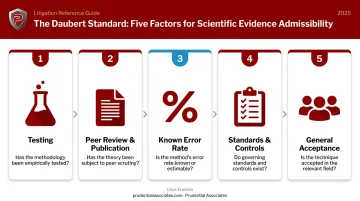
The five Daubert factors judges may consider:
- Whether the theory or technique has been tested
- Whether it has been peer-reviewed and published
- The known or potential error rate
- Whether standards and controls exist for the method
- Whether it is generally accepted in the relevant scientific community
Federal Rule of Evidence 702, amended effective December 1, 2023, added an explicit burden: the proponent of expert testimony must demonstrate to the court that it is more likely than not that the rule's admissibility requirements are satisfied. This is a meaningful shift — parties can no longer simply assert reliability; they must prove it.
The 2023 amendment reinforced what Kumho Tire Co. v. Carmichael (526 U.S. 137, 1999) established decades earlier: Daubert's gatekeeping function extends beyond pure science to all expert testimony under FRE 702, including technical and specialized knowledge. Forensic disciplines that fall outside traditional science — tool mark analysis, bite mark comparison, or digital artifact interpretation — are not exempt from judicial reliability scrutiny.
The Four Requirements for Forensic Evidence to Be Admissible
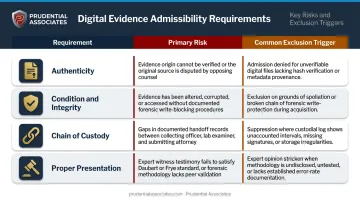
The NIJ's Law 101 framework identifies four requirements evidence must satisfy to be admissible: it must be authentic, in good condition, able to withstand scrutiny of collection and preservation procedures, and properly presented through required legal procedures. Defense attorneys routinely target all four — and any gap is enough to keep evidence out.
Here's what each requirement means in practice, and where it most often breaks down.
Authenticity
Evidence must be what it claims to be — genuine, unaltered, and traceable to its source. Authenticity is established through foundational or "predicate" testimony: who collected the evidence, when, where, and under what circumstances. Attorneys must answer these questions before evidence can be shown to a jury. If the foundation is weak, the opposing party can object before the exhibit ever reaches the fact-finder.
Condition and Integrity
Evidence must reflect its original or collected state. For physical forensic evidence, degradation and contamination are the primary concerns. For digital evidence, the risks are technical: improper imaging, failure to use write-blockers, or working from an unverified copy can silently alter the data — and courts have excluded digital evidence on exactly these grounds.
Chain of Custody
Courts require a documented, unbroken chain of custody tracing the evidence from collection through every transfer, analysis, and storage point. The NIJ's chain of custody standard requires answers to five foundational questions:
- Who seized the evidence?
- When was it seized?
- Where has it been since?
- How was it preserved?
- What records confirm preservation?
Gaps in any of these answers give opposing counsel a viable exclusion argument. That risk carries directly into how evidence is presented at trial.
Proper Presentation
Even authentic, well-preserved evidence can be excluded if it isn't offered into the record correctly. Physical exhibits require witness testimony to lay the foundation. Expert-created items — forensic reports, digital extractions, analytical conclusions — require additional foundational testimony establishing the expert's qualifications and the methodology used to produce the findings.
Here's how the four requirements interact in practice:
| Requirement | Primary Risk | Common Exclusion Trigger |
|---|---|---|
| Authenticity | Weak foundation testimony | No witness to establish origin |
| Condition & Integrity | Degradation or digital alteration | Unverified copy, no write-blocker |
| Chain of Custody | Documentation gaps | Missing transfer records |
| Proper Presentation | Procedural errors | Unqualified expert, missing methodology |
What Types of Forensic Evidence Are Allowed in Court
Courts have admitted a wide range of forensic evidence types, but admissibility varies by jurisdiction and is subject to ongoing scientific scrutiny. The spectrum of acceptance runs from highly validated to actively contested.
| Evidence Type | Acceptance Status |
|---|---|
| Nuclear DNA | Strongly validated; widely accepted across all jurisdictions |
| Latent fingerprints (ACE-V) | Foundationally valid per PCAST, but false-positive rates should be disclosed |
| Digital forensics | Accepted when proper tools, methodology, and certified examiners are used |
| Ballistics/toolmarks | PCAST found only one appropriately designed black-box study existed; validity contested |
| Bite mark evidence | PCAST found false-positive rates "so high" the method is "clearly scientifically unreliable" |
| Hair, handwriting, footwear | NAS and PCAST identified major empirical-validation gaps |
The PCAST 2016 report is particularly consequential for litigation. It distinguished between "foundational validity" (whether a method has been shown to work in controlled studies) and ordinary proficiency testing. Courts now apply this distinction directly — examiner experience alone no longer establishes that a method is reliable enough to admit.
Bite mark evidence warrants particular caution: treat it as high-risk in any jurisdiction applying Daubert, whether you're relying on it or opposing it. The Texas Forensic Science Commission issued a moratorium on its use following the PCAST findings, and a 2023 NIST scientific foundation review reinforced those reliability concerns.
Chain of Custody: Why It Can Make or Break Your Case
Chain of custody isn't a formality. It's the mechanism courts use to confirm that the evidence being evaluated is the same evidence collected at the scene—unaltered, uncontaminated, and traceable at every step.
A broken or poorly documented chain gives opposing counsel grounds to argue that evidence was tampered with, mixed up with other samples, or degraded through improper handling. The argument doesn't require proof of actual tampering—only that the documentation leaves that possibility open.
What Proper Chain of Custody Documentation Includes
- Identity and role of every person who handled the evidence
- Timestamps for each transfer or change in custody
- Descriptions of how evidence was sealed, stored, and transported
- Laboratory intake records and analysis logs
For digital forensic evidence, the requirements extend further. Proper documentation includes:
- Hash values (MD5, SHA-1, SHA-256) generated at acquisition and verified after imaging
- Write-blocker use records confirming that original media was not modified during examination
- Device seizure logs documenting the condition and state of the device at collection
- Tool validation records showing the examiner used verified, accepted forensic software

Firms like Prudential Associates build these procedures into their standard acquisition process, using cryptographic hashing and write-blocking as baseline practice with every step documented for legal defensibility.
Chain of custody problems are almost always preventable. They arise when documentation is inconsistent, transfers are unrecorded, or evidence is handled by personnel unfamiliar with forensic standards. Engaging certified forensic professionals from the moment of collection—not after the fact—is the most reliable way to avoid exclusion arguments at trial.
Digital Forensic Evidence and Modern Admissibility Challenges
Digital forensic evidence—extracted from computers, smartphones, cloud accounts, email systems, social media platforms, and network logs—now appears in the majority of criminal prosecutions and a growing share of civil disputes. Courts accept it, but the technical bar for admissibility is specific.
Acquisition and Integrity Requirements
Digital evidence must be collected using forensically sound methods that preserve an exact copy of the original data without modifying it. The standard approach involves:
- Creating a bit-for-bit forensic image of the original storage media
- Generating hash values at acquisition and verification stages to confirm the image matches the original
- Using write-blockers to prevent any data from being written to the original device during imaging
- Employing validated tools—such as EnCase, Cellebrite UFED, or Magnet AXIOM—that have been tested through NIST's Computer Forensics Tool Testing Program
Hash verification is the digital equivalent of tamper-evident packaging. If the acquisition hash and the verification hash match, the forensic image is a proven, unaltered copy. If they don't match, opposing counsel has grounds to challenge the entire chain of custody — and courts have excluded evidence on that basis alone.
Sound acquisition practices get evidence through the door. What keeps it there is the examiner standing behind it.
Examiner Qualifications Under Daubert
Courts evaluate the digital forensic examiner's qualifications and methodology under the same FRE 702 framework applied to other experts. In United States v. Ganier (468 F.3d 920, 6th Cir. 2006), the court confirmed that computer forensic work constitutes scientific, technical, or specialized knowledge under Rule 702—meaning the examiner's methods must satisfy the reliability analysis.
Certifications directly support this analysis. Credentials such as:
- EnCE (EnCase Certified Examiner)
- CFCE (Certified Forensic Computer Examiner)
- GCFA (GIAC Certified Forensic Analyst)
- Cellebrite Certified Physical Analyst and UFED Physical and Logical Pro
- MCFE (Magnet Certified Forensic Examiner)
These credentials demonstrate that an examiner has been trained and tested to established industry standards. They don't guarantee admissibility, but they provide a documented foundation that withstands qualification challenges on cross-examination.

Prudential Associates' Rockville-based forensic laboratory holds these credentials across its examiner team, with casework spanning smartphone data, social media warrant returns, call detail records, email forensics, and cloud artifacts — all prepared with courtroom presentation in mind.
How Forensic Evidence Gets Challenged—and How to Defend It
Attorneys challenge forensic evidence through three primary mechanisms: pre-trial Daubert hearings, chain of custody objections, and cross-examination of the testifying expert. Understanding each mechanism helps both sides prepare.
Common Grounds for Exclusion
The most frequently successful challenges target:
- Unvalidated methodology: No empirical black-box studies demonstrating how often examiners reach accurate conclusions
- Protocol deviations: The examiner departed from established procedures without documented justification
- Broken chain of custody: Documentation gaps that leave open the possibility of tampering or contamination
- Overstated conclusions: The expert claimed more certainty than the underlying science supports
- Proficiency tests ≠ error rate studies: PCAST explicitly noted that lab proficiency tests are not the same as foundational validity studies; courts have begun treating this distinction as grounds for exclusion

Building a Forensically Defensible Case
Defense begins at collection, not at trial. Practical steps that reduce admissibility risk:
- Engage certified forensic professionals immediately — before evidence is collected, moved, or analyzed
- Document everything in real time — contemporaneous records are far more credible than reconstructed ones
- Use validated tools with published testing records — tools tested through NIST's CFTT program have a documented validation trail
- Retain experts who can explain their methods plainly — a technically correct methodology that a jury can't understand creates its own problems at trial
- Review opposing forensic evidence — Prudential Associates regularly conducts independent reviews of government or opposing party digital forensic reports, assessing methodology, chain of custody, and the strength of conclusions presented to counsel
At a Daubert hearing, preparation wins. An expert who walks into court with documented methodology, cited error rate studies, and a clear audit trail survives challenges that sink examiners who rely solely on credentials and experience.
Frequently Asked Questions
What are the four requirements for evidence to be admissible at trial?
Evidence must be authentic, in a condition reflecting its original state, supported by a documented chain of custody, and properly presented through testimony or applicable evidentiary rules. All four requirements must be satisfied before evidence reaches the fact-finder.
What type of forensic evidence is allowed in court?
Courts have admitted DNA, fingerprints, digital forensics, ballistics, toxicology, blood spatter analysis, and more. Admissibility depends on whether the method meets the Daubert or Frye standard in the relevant jurisdiction. Evidence lacking empirical validation—such as bite mark analysis—faces increasing challenges and restrictions in some states.
Is the Frye Standard still used?
Yes, in several states including California, New York, Illinois, and Pennsylvania. Most U.S. federal courts and many state courts now apply the Daubert Standard under FRE 702, which requires a more rigorous scientific reliability analysis rather than simple general acceptance within a field.
What makes digital forensic evidence admissible in court?
Digital forensic evidence must be collected using forensically sound tools, with hash values confirming no data was altered and a complete chain of custody covering device seizure logs and write-blocker records. The examining analyst must also meet FRE 702's qualifications and use a methodology that satisfies its reliability requirements.
What is chain of custody and why does it matter?
Chain of custody is the documented record of every person who handled evidence from collection through courtroom presentation. Gaps in that record give opposing counsel grounds to argue tampering or contamination — and they need only show the documentation makes it possible, not prove it actually occurred.
Can forensic evidence be challenged or excluded at trial?
Yes. Forensic evidence can be excluded through pre-trial Daubert hearings, motions to suppress, or sustained cross-examination challenges. Common grounds include unvalidated methodology, broken chain of custody, inflated error rate claims, or an examiner who lacks the qualifications required under FRE 702.