The financial stakes are not abstract. According to IBM's 2025 Cost of a Data Breach Report, the global average cost of a data breach now stands at $4.4 million — and that figure doesn't capture ransomware specifically, where Sophos reports average recovery costs of $1.5 million on top of ransom payments averaging $1.0 million.
This guide covers what computer forensics actually is, how the four NIST-recognized investigative stages work, how to structure a cyber attack recovery, and what legal obligations determine whether your evidence holds up.
TL;DR — Key Takeaways
- Forensic investigation and system recovery must run simultaneously — not sequentially
- The four NIST forensic stages are: Collection, Examination, Analysis, and Reporting
- Chain of custody determines whether digital evidence is legally admissible
- Most organizations benefit from certified external forensic experts, especially when litigation or regulated data is involved
What Is Computer Forensics and Why Does It Matter?
Computer forensics — also called digital forensics or cybersecurity forensics — is the discipline of identifying, collecting, preserving, and analyzing digital evidence following a cyber incident. The goal is twofold: understand what happened operationally, and produce findings that are legally admissible. This applies both reactively after a breach and proactively when identifying vulnerabilities before attackers exploit them.
Beyond "Finding the Hacker"
Organizations often think of forensics narrowly — catch the attacker, close the case. In practice, a forensic investigation serves several distinct functions:
- Damage assessment: what data was accessed, altered, or exfiltrated
- Regulatory compliance: HIPAA, SEC, and state breach laws require scoping facts before notification
- Litigation support: evidence for criminal prosecution or civil claims
- Security improvement: identifying the control gaps that made the breach possible
Without forensic capability, as NIST SP 800-86 states directly, an organization has difficulty determining what events occurred within its systems and networks. Those gaps in visibility become costly — operationally, legally, and reputationally.
Forensics vs. IT Incident Response
Each of those functions depends on evidence that survives the incident — which is exactly where forensics and IT operations run into conflict. These two disciplines have different objectives that can clash when not coordinated:
- IT incident response prioritizes restoring operations quickly
- Forensic investigation prioritizes preserving evidence integrity
Done poorly together, one destroys what the other needs. Reimaging a server restores operations but eliminates forensic artifacts. This tension is why DFIR (Digital Forensics and Incident Response) exists as an integrated discipline. It combines both objectives under a single coordinated framework so neither is sacrificed.
The Four Stages of the Computer Forensic Process
NIST SP 800-86 defines four core stages that all forensic investigations must follow. Each stage builds directly on the previous one — deviating from this sequence can compromise evidence integrity and admissibility.

Stage 1: Collection
Collection involves identifying, labeling, recording, and acquiring data from all relevant sources:
- Hard drives, SSDs, and removable media
- RAM and active memory
- Network logs, firewall logs, and DNS records
- Mobile devices and tablets
- Cloud environments and SaaS application logs
- Email servers
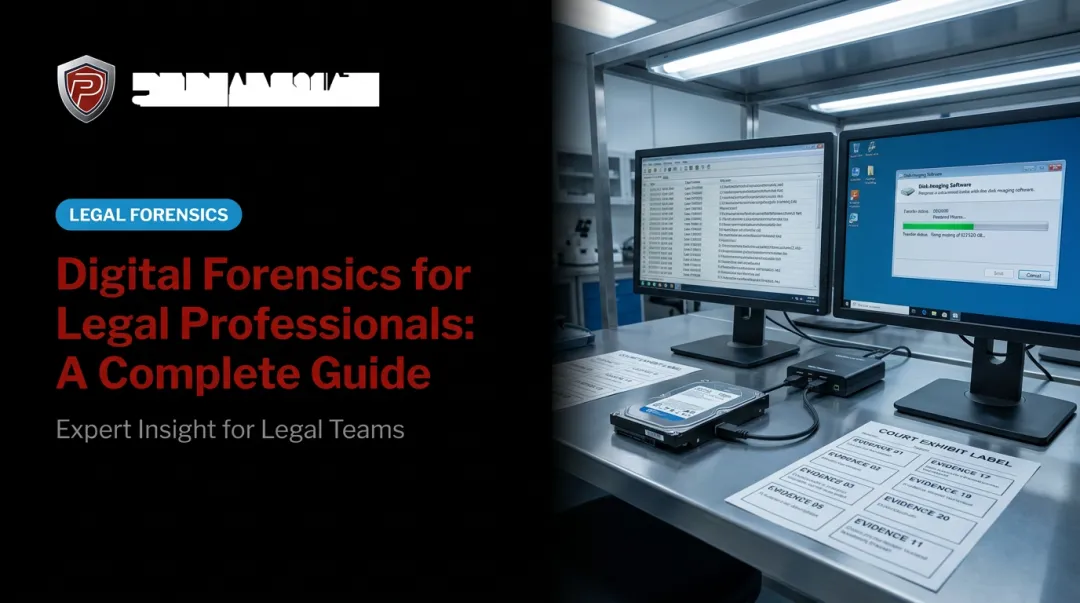
Two principles govern this stage. First, investigators never work on original evidence — they create verified forensic copies (disk images) using write-blockers that prevent any modification to the source.
Second, volatile data must be captured first. RAM contents, active network connections, running processes, and login sessions disappear the moment a system powers down — any delay means permanent evidence loss.
Prudential Associates is explicit on this point in its response guidance: immediate shutdown should be avoided unless there is an imminent risk to safety, because powering off permanently eliminates volatile forensic artifacts that often reveal how the intrusion occurred.
Stage 2: Examination
Examination is the systematic filtering of collected data to extract relevant artifacts. Examiners are looking for:
- Deleted files recovered from unallocated disk space
- Decoded metadata revealing file creation, modification, and access times
- Anomalous log entries indicating unauthorized access
- Indicators of compromise (IOCs) — malware signatures, suspicious executables, unusual network connections
Common platforms used at this stage include EnCase, FTK (Forensic Toolkit), and Autopsy. Trained examiners apply structured methods with these tools to surface evidence that isn't immediately visible in raw data.
Stage 3: Analysis
Once artifacts are extracted, investigators correlate them to reconstruct a coherent picture of the attack:
- Initial entry point — phishing, exploited vulnerability, compromised credentials
- Lateral movement — how the attacker moved through the environment
- Data accessed or exfiltrated — scope of the breach
- Dwell time — how long the attacker was present before detection
Threat intelligence feeds often link findings to known threat actor groups or malware families. The primary deliverable of this stage is root cause analysis — a finding that answers not just what happened, but how and why.
Stage 4: Reporting
The forensic report is the investigation's final output. It must be usable by non-technical audiences — attorneys, regulators, insurers, and executives — without sacrificing technical rigor. A complete report includes:
- Documented methodology and tools used
- Chain of custody records
- Chronological timeline of attacker activity
- Technical findings in plain language
- Actionable remediation recommendations
Prudential Associates' reports include formal assignment summaries, hash verifications, evidentiary exhibits, and detailed timelines — structured specifically so findings can withstand legal scrutiny and regulatory audit.
Types of Computer Forensic Investigations
Modern attacks rarely stay within one environment. Attackers pivot from endpoint to network to cloud, meaning a thorough investigation often requires multiple forensic disciplines working in parallel.
The Four Primary Disciplines
| Discipline | Focus Area |
|---|---|
| Computer/Disk Forensics | Physical storage devices, servers, endpoints — deleted files, logs, malware |
| Network Forensics | Captured traffic, firewall logs, DNS activity — attacker movement and data exfiltration |
| Mobile Device Forensics | Smartphones and tablets — deleted messages, app data, location history |
| Cloud Forensics | Cloud platforms and SaaS environments — complicated by multi-tenancy and limited direct infrastructure access |

Mobile forensics is particularly relevant when insider threats or employee misconduct is suspected. Prudential Associates holds multiple Cellebrite certifications (CCO, CCPA, UFED Physical and Logical Pro) along with GIAC Advanced Smartphone Forensics (GASF) and Certified Mobile Forensics Examiner (CMFE) credentials — enabling recovery of deleted messages, call logs, and app data from devices that have been wiped or factory reset.
Emerging Investigation Types
Two disciplines now matter for virtually any organization that handles sensitive data or has faced a ransomware demand:
- Dark web monitoring — tracking stolen credentials, data listings, and attacker activity across dark web marketplaces, encrypted forums, and paste sites. Prudential Associates conducts continuous dark web scans and, where warranted, undercover operations to gather intelligence on impending threats.
- Cryptocurrency transaction tracing — following ransom payments or fraud proceeds on the blockchain using specialized analytics platforms to identify wallet attribution and link transactions to real-world entities. Notably, Chainalysis reported that crypto ransomware payments dropped roughly 35.8% year-over-year in 2025 — a direct result of law enforcement and forensic firms getting far better at tracing these transactions.
Cyber Attack Recovery: A Step-by-Step Framework
The critical principle: recovery and forensic investigation must run simultaneously, not sequentially. Restoring systems before preserving evidence destroys the forensic record.
The recovery framework follows six phases — Preparation, Identification, Containment, Eradication, Recovery, and Lessons Learned. Here's how the operational phases break down in practice.
Containment and Isolation
Immediate containment actions should include:
- Isolate affected systems from the network (via physical cable removal or controlled interface isolation) without powering them down
- Disable compromised accounts and revoke elevated privileges
- Preserve firewall rules and network segmentation configurations as-is
- Capture volatile data (RAM, active connections) before any further action
- Document every step: containment actions become part of the forensic record

Every action taken during this phase affects chain of custody. An undocumented containment step can create evidentiary gaps that undermine subsequent legal proceedings — which is why documentation is built into the numbered list above, not treated as an afterthought.
Damage Assessment and Scope Definition
Before remediation begins, investigators must define what was actually breached:
- Which systems were accessed or compromised
- What data was exfiltrated or encrypted
- Whether backdoors or persistence mechanisms remain active
- How long the attacker was present — median dwell time globally is now 14 days according to Mandiant's M-Trends 2026, meaning most organizations are responding weeks after initial compromise
That 14-day window matters enormously for scope definition. An attacker present for two weeks has had time to move laterally, establish multiple footholds, and stage data for exfiltration — none of which is visible without structured forensic analysis.
Eradication and System Hardening
Malware deletion is the starting point, not the finish line. Full eradication requires:
- Close exploited vulnerabilities and apply patches
- Revoke all attacker-established access (accounts, tokens, certificates)
- Hunt for secondary persistence mechanisms — scheduled tasks, registry modifications, implanted backdoors
- Validate eradication before beginning any restoration
Partial eradication is a persistent failure point. Mandiant data shows prior compromise was the top ransomware initial infection vector in 2025 — meaning attackers frequently re-enter through footholds left behind after incomplete remediation.
Restoration and Validation
Sophos reported that in 2024, attackers attempted to compromise backups in 94% of ransomware incidents and succeeded in 57%. Restoring from a compromised backup reintroduces the attacker into a freshly rebuilt environment — making backup validation a non-optional step.

Validated restoration requires:
- Confirming backups were isolated from the attack before using them
- Performing forensic acquisition before restoration to document pre-restoration state
- Validating restored systems are clean before reconnecting them to the network
- Monitoring continuously during the restoration window
Post-Incident Review and Notification Obligations
The lessons-learned phase closes the loop and triggers legal obligations:
- Root cause documentation drives targeted remediation
- Security control gaps identified during the investigation inform updated policies
- Legal notification deadlines begin running from the moment of discovery
| Regulation | Deadline | Trigger |
|---|---|---|
| HIPAA | 60 calendar days | Date of discovery |
| SEC Item 1.05 (Form 8-K) | 4 business days | After materiality determination |
| State breach laws | Varies | All 50 states + DC, Guam, Puerto Rico, USVI |
The forensic report is what makes compliant notification actionable. Without documented scope, timeline, and affected data, organizations cannot accurately complete the disclosures these deadlines require.
Legal Considerations, Chain of Custody, and Evidence Integrity
What Chain of Custody Actually Means
Chain of custody is the documented, unbroken record of who collected evidence, how it was handled, where it was stored, and who accessed it at each stage. A broken chain can render digital evidence completely inadmissible, making prosecution or civil remedies impossible even when the technical findings are sound.
Prudential Associates maintains documented chain of custody across every engagement, with each acquisition, handling step, and analysis activity logged to ensure forensic findings remain defensible for regulatory review or legal proceedings.
Evidence Integrity Through Cryptographic Hashing
Forensic examiners generate a cryptographic hash (a unique digital fingerprint) of every piece of evidence at the moment of collection. Forensic examiners re-verify that hash at each subsequent stage. Any alteration — even accidental — produces a different hash and can invalidate the investigation.
This is why common IT practices — modifying logs, restoring from backups, reimaging systems — can destroy forensic integrity. What looks like routine IT work can eliminate the evidentiary foundation of an entire investigation.
Regulatory Obligations Make Forensics Non-Optional
For organizations in regulated industries, forensics isn't a choice:
- HIPAA requires breach notification facts, including scope, affected individuals, and type of data exposed
- SEC rules require disclosure of material cybersecurity incidents with specific detail on nature, scope, and impact
- State breach laws in all 50 states require notification, with varying timelines and content requirements
Regulators expect organizations to demonstrate they conducted a thorough investigation — not simply that they restored operations.
Engaging Attorneys Early
Legal counsel should be engaged at the outset of any significant incident, not after the forensic investigation concludes. Attorney involvement from the start provides several critical protections:
- Establishes attorney-client privilege over investigation findings
- Ensures breach notification timelines are met under applicable laws
- Positions the organization appropriately if criminal prosecution or civil litigation follows
Prudential Associates coordinates directly with client counsel to ensure that before any findings are shared with law enforcement, appropriate legal approvals are in place.
When to Bring in a Professional Forensic Expert
In-house IT teams handle routine incidents effectively. Certain situations require certified external experts.
Clear Signals You Need External Forensics
- Suspected insider threat: employee investigations require neutrality that internal teams can't objectively provide
- Ransomware with potential data exfiltration: full scope must be confirmed before any payment decision
- Regulated data at risk: HIPAA, PCI-DSS, or legal discovery requirements demand documented forensic process
- Criminal prosecution or civil litigation pending: evidence must meet court admissibility standards from the moment of collection
- Skills gap confirmed: Sophos reports that 63% of ransomware victims cited lack of people or skills as a contributing factor, and 40% had an unknown security gap at the time of compromise
What to Look for in a Forensic Firm
Not all forensic firms are equal. Evaluate on:
- Certifications: GCFA, EnCE, CFCE, CISSP, and CEH at minimum
- Legal proceedings experience: court-admissible reports, expert witness testimony, and law enforcement coordination
- Chain of custody methodology: documented protocols that hold up under judicial or regulatory scrutiny
- Full-environment capability: endpoints, networks, mobile devices, and cloud
Prudential Associates, operating since 1972, holds all five of those certifications plus more than 30 additional credentials — including GIAC GNFA, GREM, GASF, Cellebrite UFED, and OSCP. The firm's CEO has testified as a digital forensics expert in 500+ court proceedings at local, state, and federal levels.
The team includes former FBI special agents, CIA officials, and U.S. State Department veterans, combining law enforcement investigative methodology with forensic technical depth that matters when evidence must hold up before a judge or regulator. The firm's 2026 partnership with CrowdStrike extends these capabilities into the MDR space, adding enterprise-grade threat detection to an already comprehensive incident response practice.

The Case for a Forensic Retainer
Organizations should have a forensic relationship established before an incident occurs. A retainer provides:
- Pre-negotiated response terms and faster mobilization
- Familiarity with the organization's environment
- Priority evidence collection during the critical first hours
- Alignment with cyber insurance requirements — insurers increasingly require documented incident response arrangements
Finding a qualified forensic firm mid-breach costs time you don't have — and that delay directly affects both evidence quality and recovery outcomes.
Frequently Asked Questions
What is the first step in a cyber forensic investigation?
The first step is evidence collection — specifically capturing volatile data (RAM, active network connections, running processes) before anything else. This data disappears when systems power down. All collection must follow strict chain of custody procedures from the first moment.
What are the four stages of the computer forensic process?
The four NIST-defined stages are:
- Collection — gathering evidence from all relevant sources
- Examination — extracting relevant artifacts
- Analysis — reconstructing events and identifying root causes
- Reporting — documenting findings for legal, regulatory, or organizational use
Who investigates cyber attacks?
In-house IT/security teams, specialized DFIR firms, and law enforcement agencies (FBI Cyber Division, Secret Service) all investigate cyber attacks. When litigation, regulated data, or potential criminal prosecution is involved, certified forensic experts with law enforcement investigative experience are required.
How much does a computer forensic investigation typically cost?
Costs depend on the number of affected systems, data volume, complexity, and whether litigation support is needed — a single-device examination differs considerably from a multi-server breach investigation. A retainer agreement established before an incident typically reduces both cost and response time. Contact a forensic firm directly to discuss scoped pricing.
Can forensics recover deleted text messages?
Yes: mobile forensic investigators can often recover deleted messages, call logs, and app data using tools such as Cellebrite UFED. Success depends on the device model, operating system, encryption state, and time elapsed since deletion.
Why is data backup and recovery important in computer forensics?
Verified, isolated backups restore systems to a known-clean state and serve as forensic reference points — helping investigators establish what existed before the attack and what was altered, exfiltrated, or encrypted. Compromised backups are among the most common recovery failure points in ransomware incidents.