Without a documented process, security teams improvise under pressure. That improvisation destroys evidence, delays containment, and leaves leadership without clear decision authority — exactly when clarity matters most. IBM's 2025 Cost of a Data Breach Report puts the global average breach cost at $4.44 million, with a mean time to identify and contain of 241 days. Organizations that reduce that window protect both their finances and their reputation.
This guide is written for security teams, IT managers, legal counsel, and business leaders at corporate and government organizations. It walks through all six steps of the SANS incident response framework — Preparation, Identification, Containment, Eradication, Recovery, and Lessons Learned — and highlights the practical decisions that determine whether a response succeeds or fails.
Key Takeaways
- Cyber incident response is the structured process organizations follow when a breach occurs — improvising without one leads to costly, preventable mistakes
- The SANS framework defines 6 sequential steps: Preparation, Identification, Containment, Eradication, Recovery, and Lessons Learned
- Preparation is the most critical step — everything else depends on work done before an incident occurs
- Thorough documentation at every step supports forensic investigations and satisfies regulatory requirements
- Treat incident response as a continuous cycle: each incident should sharpen future readiness
What Is Cyber Incident Response?
Cyber incident response is the organized methodology by which an organization detects, investigates, contains, and recovers from a cybersecurity event threatening its systems, data, or operations.
The process is designed to achieve four outcomes:
- Limit the scope of damage
- Preserve forensic evidence for investigation and legal proceedings
- Restore normal operations as quickly as possible
- Reduce the likelihood of repeat incidents
Achieving those outcomes consistently requires a structured framework. Two models dominate the field: NIST's SP 800-61 (updated to Rev. 3 in April 2025) defines a 4-phase lifecycle — Preparation; Detection and Analysis; Containment, Eradication, and Recovery; and Post-Incident Activity. SANS separates those middle phases into individual steps, producing the 6-step PICERL model. This guide follows SANS because the additional granularity is more actionable for operational teams executing a response in real time.
Why Organizations Need a Formal Cyber Incident Response Process
Without a formal plan, the consequences compound quickly:
- Response teams make judgment calls without authority
- Critical evidence gets overwritten or deleted before it can be preserved
- Containment stalls while ownership is debated
- Leadership receives inconsistent information at the worst possible moment
Ponemon research found that 34% of organizations lacked a fully functional CSIRT, and only 21% conducted ongoing readiness assessments such as tabletop exercises or red teaming. More than half of IR teams lacked clearly defined rules of engagement.
Regulatory and Legal Obligations
A formal incident response process isn't just operationally sound — it's legally required in many contexts. Organizations subject to the following frameworks have explicit incident handling obligations:
- HIPAA: Breach notification due within 60 calendar days of discovery
- GDPR Article 33: Supervisory authority notification required within 72 hours where feasible
- SEC: Material cybersecurity incidents disclosed on Form 8-K within 4 business days of materiality determination
- FISMA/CISA: Federal agencies must report incidents within 1 hour of identification
- State breach notification laws: All 50 U.S. states, DC, Guam, Puerto Rico, and the Virgin Islands have enacted breach notification requirements

NIST SP 800-61, SANS, and CISA all endorse formal incident response as a baseline. Missing these deadlines exposes organizations to regulatory fines, civil liability, and reputational damage that far exceed the cost of preparation.
The 6 Steps of Cyber Incident Response
Step 1: Preparation
Preparation is the foundation every other step depends on. No amount of technical skill during an active incident compensates for the absence of pre-built plans, trained personnel, and deployed tooling.
Effective preparation includes:
- CSIRT assembly: Defined roles across security, legal, management, communications, and IT — with documented authority and escalation paths
- Policy and playbook development: A high-level IR plan plus role-specific playbooks for specific attack types (ransomware, phishing, insider threat, supply chain compromise)
- Detection infrastructure: SIEM deployment, endpoint detection and response (EDR), IDS/IPS, and logging pipelines configured before any incident occurs
- Readiness testing: Tabletop exercises, red team engagements, and crisis simulations to validate that plans work under pressure
The build-vs.-partner question is real for most organizations. Teams without dedicated IR expertise should consider retaining an external partner before an incident — not during one. Prudential Associates, operating since 1972, combines over five decades of intelligence and investigative experience with GCIH, GCFA, CISSP, and OSCP-certified personnel, plus a CrowdStrike partnership, to provide both the human expertise and platform technology organizations need for sound preparation.
Step 2: Identification
Identification is the process of determining whether an anomaly constitutes a genuine security incident. Not every alert is an incident — a 2024 Ponemon/Sullivan study found organizations receive an average of 22,111 security alerts per week, including 9,854 false positives, with only 35% of alerts actually investigated.
Analysts review logs, IDS/IPS alerts, endpoint telemetry, and user-reported events to distinguish true indicators of compromise (IOCs) from noise. When an incident is validated, it must be formally declared and documented.
Incident prioritization matters immediately. Common severity classifications:
| Priority | Description | Example |
|---|---|---|
| P1 | Critical — major business impact | Full system compromise, active data exfiltration |
| P2 | Significant but contained | Isolated endpoint compromise with lateral movement indicators |
| P3 | Moderate — limited impact | Phishing attempt with credential access |
| P4 | Low severity / informational | Failed login attempts, policy violations |
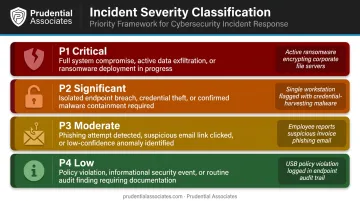
Priority level determines response urgency, stakeholder notifications, and resource allocation. Getting this classification right early saves time throughout the remainder of the process.
Mandiant's M-Trends 2025 report found global median dwell time of 11 days — meaning attackers operated undetected for nearly two weeks on average before identification. Internal detection occurred in 52% of investigations. The rest were discovered by external parties or the attackers themselves.
Step 3: Containment
The primary objective of containment is to stop further damage without destroying forensic evidence. These two goals are in tension — moving too fast destroys evidence; moving too slow expands the blast radius.
Short-term containment actions (taken immediately):
- Isolate infected endpoints from the network
- Block malicious IP addresses and domains at the perimeter
- Disable compromised accounts
- Preserve volatile memory before powering down any system
Long-term containment actions (stabilization):
- Apply temporary patches to limit exposure
- Rebuild clean parallel systems where needed
- Implement additional monitoring on adjacent systems
Forensic imaging of affected systems must occur before any remediation. Capturing system state — including memory, logs, and disk images — preserves evidence needed for root cause analysis, legal proceedings, and regulatory reporting. The FTC's breach response guidance is explicit: do not alter, move, or delete files that may show how the breach happened.
Prudential Associates maintains strict chain-of-custody protocols and forensically sound acquisition practices from the first response action onward, ensuring evidence gathered during containment holds up in legal and regulatory proceedings.
Step 4: Eradication
Eradication means complete removal of all malicious presence from the environment. Containment stopped the spread; eradication eliminates the threat entirely.
The eradication checklist includes:
- Identify all affected hosts across the environment
- Remove malware and all attacker-planted backdoors
- Patch or mitigate every exploited vulnerability
- Reset all compromised credentials
- Harden affected systems before returning them to service

Incomplete removal is one of the most common failure points in incident response. The Verizon 2025 DBIR found vulnerability exploitation accounted for 31% of breaches — meaning unpatched vulnerabilities frequently enable re-entry. Mandiant's M-Trends 2025 report identifies prior compromise as a top ransomware initial infection vector at 30%, which reflects organizations that were re-compromised through persistence mechanisms missed during eradication.
Prudential Associates holds GIAC Reverse Engineering Malware (GREM) certification, which directly supports deep malware analysis — identifying precisely what was installed, what persistence mechanisms were deployed, and whether any components were missed. This level of analysis is what separates thorough eradication from incomplete removal.
Step 5: Recovery
Recovery is the carefully controlled reintegration of cleaned systems back into production. Speed is not a virtue here — rushing systems online before full verification is a leading cause of repeat incidents.
NIST's recovery guidance specifies:
- Restore from verified clean backups
- Rebuild systems where necessary
- Replace compromised files
- Install all applicable patches
- Reset passwords and credentials
- Increase monitoring on restored systems
Before any system returns to production, system owners — in consultation with the CSIRT — should confirm it has been validated clean, that exploited vulnerabilities are remediated, and that enhanced monitoring is in place. Recovery decisions driven by operational pressure alone, without that verification, frequently produce a second incident within days or weeks.
Post-restoration monitoring should continue for a defined window, typically 30 to 90 days depending on incident severity, watching for abnormal behavior that might indicate a persistence mechanism was missed.
Step 6: Lessons Learned
A formal post-incident review should occur as soon as possible after the incident — while details are still fresh. NIST recommends this meeting for all major incidents, using findings to improve both security posture and incident handling capability.
Questions the review should answer:
- What happened, and when was it first detectable?
- How well did the CSIRT execute the response?
- What information was unavailable when needed?
- What actions slowed detection, containment, or recovery?
- What changes will prevent recurrence?
The outputs of this step close the loop:
- Updated incident response plan and playbooks
- New or improved detection rules
- A formal incident report suitable for regulatory use, training, or legal proceedings
- Intelligence fed back into the Preparation phase
This is what makes incident response a cycle rather than a checklist. Each incident, handled well, makes the next response faster and more effective.
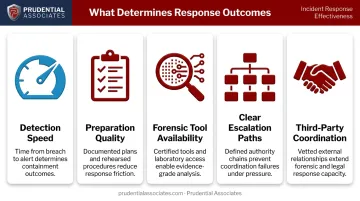
Key Factors That Affect Incident Response Effectiveness
Even well-designed processes fail when certain organizational variables aren't in place. The factors that most consistently determine response outcomes:
- Detection speed: Dwell time directly correlates with damage scope — faster identification limits how far an attacker can move
- Pre-incident preparation quality: Teams that have rehearsed their playbooks respond faster and make fewer errors under pressure
- Forensic tool availability: Evidence that isn't captured in the first hours may be unrecoverable
- Clear escalation paths: Ambiguous authority during an active incident costs hours
- Third-party and law enforcement coordination: Some incidents require external support — knowing when and how to engage that support must be planned in advance
Incident Type Changes the Approach
A one-size-fits-all playbook is insufficient for organizations facing diverse threat profiles. Each of these incident types requires a different response:
- Ransomware: Prioritizes backup integrity, decryption analysis, ransom decision framework, and recovery sequencing
- Insider threats: Requires covert investigation methodology, HR and legal coordination, and careful evidence handling to avoid tipping off the subject
- Supply chain compromises: Demands third-party notification, dependency mapping, and extended scope assessment
- Nation-state attacks: Involves law enforcement coordination, counterintelligence considerations, and long-horizon monitoring
Insider threat investigations in particular demand a different skill set than purely technical response work. Prudential Associates pairs former law enforcement professionals with certified cybersecurity analysts, applying investigative methodology — witness interviewing, chain-of-custody discipline, covert evidence collection — alongside the technical forensics that most IR firms provide alone.
Regulatory Time Constraints Are Non-Negotiable
Notification deadlines are fixed and run from discovery or materiality determination — not from containment. These clocks must be tracked from the moment an incident is identified:
- GDPR: 72-hour notification window to the relevant supervisory authority
- HIPAA: 60-day requirement for breach notification to affected individuals and HHS
- SEC Form 8-K: 4 business days from materiality determination for public companies
Compliance tracking cannot wait until recovery is complete — it begins at detection.
Common Misconceptions About Cyber Incident Response
Three misconceptions consistently undermine how organizations plan for and execute incident response. Getting these wrong isn't a theoretical problem — it produces failures at the exact moment response teams are under the most pressure.
Incident Response Begins When an Incident Is Detected
The first five steps depend entirely on work done in Step 1. An organization that hasn't completed preparation cannot execute effective identification, containment, or eradication — it can only react.
An Incident Response Plan Is the Same as a Playbook
These are distinct. A plan defines the framework, roles, governance, and general approach. Playbooks define exact step-by-step procedures for specific attack types — ransomware, phishing, insider threat, business email compromise. Having a plan without playbooks leaves teams with direction but no operational detail when it counts.
Containment and Eradication Are the Same Activity
Containment stops the bleeding while the threat remains in the environment. Eradication removes it entirely. Treating these as one step leads to incomplete removal — teams declare success after isolation without verifying that every backdoor, persistence mechanism, and compromised credential has been addressed.
Frequently Asked Questions
What are the steps of cyber incident response?
The SANS framework defines six steps: Preparation, Identification, Containment, Eradication, Recovery, and Lessons Learned. NIST's SP 800-61 condenses these into four phases, but both frameworks cover the same core activities — NIST groups containment, eradication, and recovery into a single phase where SANS treats them as distinct sequential steps.
What is incident response in cybersecurity?
Incident response is the structured process organizations use to detect, contain, and recover from security breaches. It combines technical actions — forensic analysis, malware removal, system restoration — with organizational steps such as stakeholder notification, legal coordination, and regulatory reporting, all guided by a pre-built plan.
How does NIST define incident response?
NIST SP 800-61 defines incident response as a four-phase lifecycle: Preparation; Detection and Analysis; Containment, Eradication, and Recovery; and Post-Incident Activity. The framework treats the process as cyclical rather than linear, with post-incident findings feeding back into preparation (Rev. 3 was finalized in April 2025).
What are P1, P2, P3, and P4 incidents?
These are severity classifications. P1 is critical — active data exfiltration or full system compromise. P2 is significant but contained, P3 moderate with limited impact, and P4 low-severity or informational. Priority level determines response speed, resource allocation, and escalation path.
What is the key objective of the containment phase?
The primary objective is to stop the incident from spreading while preserving forensic evidence. This means applying short-term isolation tactics — disconnecting endpoints, blocking IPs, disabling compromised accounts — alongside longer-term stabilization measures, without overwriting data needed for investigation.
What are the 5 stages of the cybersecurity lifecycle?
The NIST Cybersecurity Framework defines five functions: Identify, Protect, Detect, Respond, and Recover. CSF 2.0, released in 2024, adds a sixth — Govern. Incident response maps primarily to the Detect, Respond, and Recover functions; the broader CSF addresses overall security posture rather than active incident handling specifically.