Introduction
Trade secret theft costs the U.S. economy an estimated $180 billion to $540 billion annually — roughly 1% to 3% of GDP, according to the IP Commission's 2017 report. If anything, the shift to digital operations has expanded the attack surface.
What has changed is who's at risk. The FBI states plainly that no industry, large or small, is immune from economic espionage. A regional manufacturer with a proprietary process, a mid-size biotech with unpublished clinical data, a law firm with sensitive client records — all are viable targets.
This guide covers the full picture:
- What corporate espionage actually is and who carries it out
- How attacks are executed — from insiders to cyber intrusions
- How investigations work, step by step
- What legal options victims have
- How to reduce your exposure before a breach occurs
Key Takeaways
- Corporate espionage is the unauthorized theft of trade secrets or proprietary business information — a federal crime and grounds for civil litigation
- Threats come from outside actors (nation-state hackers, competitors) and insiders (departing employees, planted operatives)
- Professional investigations combine digital forensics, surveillance, and counterintelligence to build court-admissible evidence
- Two federal laws — the Economic Espionage Act and the Defend Trade Secrets Act — provide criminal penalties and civil remedies
- Starting an investigation early — with proper evidence preservation — is the single biggest factor in whether evidence holds up in court
What Is Corporate Espionage?
Corporate espionage is the systematic, covert acquisition of a company's trade secrets, intellectual property, or proprietary operational data — carried out by competitors, foreign actors, or malicious insiders. The key word is covert. Legal competitive intelligence — analyzing public filings, monitoring press releases, studying competitor products — is not espionage. Corporate espionage crosses into criminality when it involves theft, deception, or unauthorized access.
The Two Primary Forms
Two distinct theft categories define most cases:
- Intellectual property theft — targets inventions, formulas, source code, and R&D data
- Trade secret theft — focuses on customer lists, pricing strategies, business plans, and marketing data
Under 18 U.S.C. § 1839, a trade secret must meet two criteria: the owner took reasonable measures to keep it secret, and it derives independent economic value from not being generally known.
Corporate espionage also differs from state-sponsored economic espionage. The former is business-to-business theft. The latter involves foreign governments directing or sponsoring the theft — a distinction that carries serious consequences under federal criminal law.
Who Gets Targeted
No sector is off limits, but some face disproportionate risk. The NCSC identifies high-priority targets including:
- Defense technology and aerospace
- Biotechnology and pharmaceutical research
- Information and communications technology
- Artificial intelligence and quantum computing
- Advanced manufacturing and energy systems
Cloud storage, remote access, and interconnected supply chains have expanded the attack surface across all of these sectors — often giving bad actors multiple entry points into a single target organization.
Common Methods and Warning Signs of Corporate Espionage
Digital Attack Vectors
Cyber-based espionage typically operates through a handful of well-documented techniques:
- Phishing and spear-phishing — targeted emails designed to harvest credentials or deploy malware
- Malware and spyware — software that exfiltrates data silently over weeks or months
- SQL injection — exploiting database vulnerabilities to extract records
- Unauthorized remote access — using stolen credentials to enter internal systems
What makes these attacks particularly dangerous is how little trace they leave without forensic examination. Many breaches go undetected for months.
Nation-state actors add another layer of complexity. The FBI and CISA have identified China, Russia, and Iran as among the most active cyber actors targeting U.S. trade secrets. A documented DOJ case puts the scale in context: Chinese intelligence officers and recruited hackers allegedly ran a campaign from 2010 through 2015 using spear-phishing and malware to steal commercial aviation technology from U.S. companies.
Insider Threats and Physical Tactics
Cyber intrusions are difficult to trace — but insider threats are harder still, precisely because the attacker already has authorized access. A 2013 CERT analysis of 103 insider IP-theft cases found that 21% of attackers were former employees and over 17% were trusted business partners. Only fewer than 6% of cases were detected by software — meaning technical controls alone are not enough.
Common insider threat profiles include:
- Departing employees copying files in the weeks before resignation
- Employees recruited or coerced by competitors
- Contractors or vendors with legitimate access who are compromised
- Operatives deliberately placed inside the organization
Physical tactics extend the threat beyond the network entirely:
- Planting listening devices in conference rooms or executive offices
- Dumpster diving for discarded documents, printouts, or hardware
- Social engineering employees at industry events or trade shows
- Posing as vendors, job candidates, or auditors to gain facility access
Warning Signs Your Business May Be Targeted
Digital red flags:
- Unexplained spikes in network traffic or after-hours data transfers
- Login attempts outside normal business hours or from unusual locations
- Unusual access to sensitive file directories by accounts with no clear need
- DLP alerts on large file copies to external drives or personal cloud accounts
Behavioral and operational red flags:
- Competitors appear to know your unreleased product roadmap or pending bids
- A key employee with broad data access shows sudden behavioral changes
- Proprietary processes surface in a competitor's product shortly after an employee departs
- Employees downloading sensitive data within 30 days of resignation — a pattern flagged by CERT as a high-risk indicator

How a Corporate Espionage Investigation Works
A proper corporate espionage investigation is a multi-phase process. The methodology must be legally sound from the very first step: evidence mishandled at the start can collapse a case before it reaches court.
Step 1 — Evidence Preservation and Initial Scoping
The moment espionage is suspected, the priority is evidence preservation. At Prudential Associates, this process begins with securing affected systems and collecting digital data under strict chain-of-custody procedures. Forensic practitioners perform write-blocked, cryptographically hashed imaging of devices to ensure evidence remains unchanged from the point of collection. Every action (acquisition, handling, analysis) is documented for accountability.
What investigators are working to prevent here is a suspect learning the investigation has started. Any premature signal gives bad actors time to wipe drives, delete logs, or destroy physical materials.
Alongside preservation, investigators conduct an initial scoping assessment to answer:
- What data may have been accessed or exfiltrated?
- Which systems were compromised and over what timeframe?
- Who had authorized access to the affected data?
- Are there signs of ongoing exfiltration?
This scoping phase sets the direction for everything that follows.
Step 2 — Digital Forensics and Cyber Investigation
Forensic examination covers the full digital environment:
- Endpoint devices — computers, laptops, mobile phones, external drives
- Email and communication records — including deleted messages and forwarding rules
- Cloud storage activity — access logs, sync history, shared link creation
- VPN and network logs — identifying unusual access patterns and exfiltration pathways
- Deleted file recovery — using certified forensic tools to reconstruct removed data

Prudential Associates' examiners hold certifications including EnCE, GCFA, CDFE, CISSP, CFCE, and GCIH, among more than 30 total credentials. These certifications reflect adherence to the same forensic methodologies courts evaluate when assessing whether evidence was properly collected. CEO Jared Stern has testified as a digital forensics expert in state and federal courts on more than 500 occasions.
Dark web monitoring runs in parallel with forensic examination. Prudential's team conducts continuous scans of dark web marketplaces, forums, paste sites, and encrypted communication platforms, looking for stolen credentials, proprietary data, or intellectual property surfaced for sale. A dark web finding can confirm a breach has occurred and can identify the threat actor or downstream buyer.
Step 3 — Surveillance, Interviews, and Building the Legal Case
Physical investigation runs concurrently with digital forensics. This includes:
- TSCM sweeps to detect planted listening devices or cameras in executive offices and conference rooms
- Physical surveillance of persons of interest, conducted within legal and ethical boundaries
- Background investigations covering criminal history, civil records, financial condition, and employment verification
- Structured employee interviews that obtain witness statements in a manner supporting legal defensibility
All findings are compiled into an attorney-ready case file. Prudential Associates' forensic examiners work directly with legal counsel, producing detailed expert reports, demonstrative trial exhibits, and written declarations. The firm coordinates with counsel to determine whether to pursue criminal referral to the FBI or DOJ, civil litigation, or both — ensuring no evidence is released to law enforcement without prior legal review.
The Legal Framework for Corporate Espionage in the US
Federal Laws and Criminal Penalties
Two federal statutes govern corporate espionage:
The Economic Espionage Act of 1996 (EEA) contains two distinct provisions:
| Provision | Covers | Individual Penalty | Organizational Penalty |
|---|---|---|---|
| 18 U.S.C. § 1831 | Theft benefiting a foreign government | Up to 15 years + $5M fine | Greater of $10M or 3x value stolen |
| 18 U.S.C. § 1832 | Commercial trade secret theft | Up to 10 years | Greater of $5M or 3x value stolen |

The distinction matters. Foreign-sponsored cases under § 1831 require DOJ leadership approval and are assigned to the Counterintelligence and Export Control Section. Commercial cases under § 1832 go to the Computer Crime and Intellectual Property Section.
The Defend Trade Secrets Act of 2016 (DTSA) created a federal civil cause of action for the first time, allowing victims to file in federal court rather than relying solely on varying state trade secret laws. The FBI becomes involved when criminal prosecution is being pursued. When no criminal referral is made, victims pursue relief through the civil track outlined below.
Civil Remedies and What Victims Can Pursue
Under the DTSA and applicable state laws, victims can seek:
- Emergency injunctive relief to stop ongoing theft immediately
- Civil seizure of stolen materials in extraordinary circumstances
- Compensatory damages for actual losses and unjust enrichment
- Exemplary damages up to 2x actual damages for willful and malicious misappropriation
- Attorney's fees in cases of bad faith or willful misconduct
To prevail, a company must demonstrate three things:
- The information qualifies as a trade secret
- Reasonable protective measures were taken
- Misappropriation occurred
Courts scrutinize chain of custody closely. Professionally gathered, forensically preserved evidence is not optional — gaps in documentation can be fatal to a civil claim.
How to Protect Your Business From Corporate Espionage
Prevention is significantly cheaper than investigation. The core protective measures fall into three categories:
Foundational controls:
- Implement strict data access controls and need-to-know policies
- Require NDAs for all employees, contractors, and vendors with sensitive access
- Formally classify sensitive data and document who can access what
- Establish clear offboarding procedures — revoking credentials the day an employee departs
- Conduct regular security awareness training focused on phishing and social engineering
Technical defenses:
- Deploy data loss prevention (DLP) tools — though remember, CERT found fewer than 6% of insider IP theft cases were detected by software alone
- Conduct regular penetration testing to find vulnerabilities before attackers do
- Run periodic TSCM sweeps of sensitive meeting rooms and executive spaces
- Monitor access logs continuously for anomalous patterns
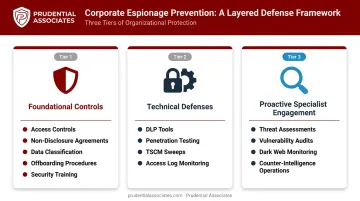
Proactive engagement with specialists:
Technical defenses alone have a ceiling. Detecting a sophisticated espionage campaign — whether from an insider or an external intelligence operation — requires investigative expertise that standard IT security firms don't carry.
Prudential Associates pairs cybersecurity capability with the experience of former law enforcement and intelligence professionals. Their counter-intelligence operations identify vulnerabilities, detect ongoing intelligence-gathering activity, and implement hardening programs before a breach occurs. Proactive engagements — threat assessments, vulnerability audits, and dark web monitoring — typically surface exposure in weeks rather than after months of undetected data loss.
Frequently Asked Questions
What qualifies as corporate espionage?
Corporate espionage involves the unauthorized acquisition of trade secrets, intellectual property, or confidential business information for competitive or financial gain. The dividing line from legal competitive research is theft, deception, or unauthorized access — not the information itself.
How do you spot a corporate spy?
Behavioral signs include unusual data access patterns, large file transfers before resignation, and unexplained contact with competitors. Technical signals include abnormal network activity and unauthorized email forwarding rules. Professional investigators use forensic tools to surface activity that standard monitoring typically misses.
Who investigates corporate espionage?
The FBI handles cases with criminal implications under the EEA. Private firms specializing in digital forensics — like Prudential Associates — are typically engaged first to gather, preserve, and analyze evidence. Legal counsel typically coordinates law enforcement involvement once evidence is secured.
Who is usually involved in corporate espionage?
The main actors are current or departing employees, outside operatives hired by competitors, foreign government-sponsored actors, and compromised contractors or vendors. According to CERT research, former employees and trusted business partners account for nearly 40% of insider IP theft cases combined.
Can you sue for corporate espionage?
Yes. Victims can pursue civil litigation under the federal Defend Trade Secrets Act or applicable state law, seeking injunctions, actual damages, and unjust enrichment recovery. In willful cases, courts can award exemplary damages up to 2x actual damages plus attorney's fees.
Can you go to jail for corporate espionage?
Yes. The Economic Espionage Act carries up to 10 years for commercial trade secret theft and up to 15 years when the theft benefits a foreign government. Fines reach $5 million for individuals — and organizational penalties can reach $10 million or three times the value of the stolen trade secret, whichever is greater.