According to the FBI, the annual cost to the U.S. economy from counterfeit goods, pirated software, and theft of trade secrets ranges from $225 billion to $600 billion. For individual companies, the damage can be existential — lost market position, costly litigation, and a competitive advantage that simply evaporates.
Digital forensics has become the primary mechanism for detecting IP theft, building the evidentiary record, and transforming a suspicion into a prosecutable case. Without a forensically sound investigation, organizations often can't prove what was taken, how, or by whom.
This article covers what IP theft looks like today, how digital forensics investigations actually work, landmark cases where forensic evidence was decisive, and what organizations should do when they suspect theft has occurred.
Key Takeaways
- IP theft costs the U.S. economy up to $600 billion annually, and most incidents go undetected without proactive forensic review
- Insider threats (particularly departing employees) account for a large share of IP theft cases
- Digital forensics establishes who accessed what, when, and where data went — producing court-admissible evidence
- High-profile cases like Waymo v. Uber and AMSC v. Sinovel were resolved largely through forensic evidence
- Engage a certified forensic firm immediately upon suspecting theft, before internal IT teams can alter potential evidence
What Is Intellectual Property Theft and Why It Matters
The Four Categories of IP
The USPTO recognizes four distinct categories of intellectual property, each carrying different legal protections:
- Patents — protect inventions and proprietary processes (governed by Title 35, U.S. Code)
- Trademarks — protect brand identifiers like logos and names (Lanham Act)
- Copyrights — protect original creative works including software and documentation (Title 17, U.S. Code)
- Trade secrets — protect confidential business information with commercial value, including formulas, algorithms, and customer lists (Economic Espionage Act and the Defend Trade Secrets Act)
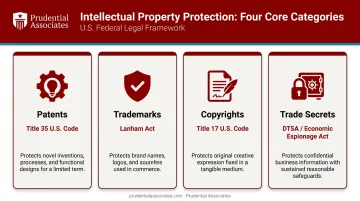
The type of IP involved directly shapes the forensic approach. Trade secret cases focus on access logs and data exfiltration paths; copyright infringement cases typically center on source code comparison and evidence of unauthorized reproduction.
What Constitutes Theft — and Why It Often Goes Unnoticed
IP theft is the unauthorized use, reproduction, exfiltration, or distribution of protected material. That covers a wide spectrum — from an employee accidentally uploading a proprietary document to a personal cloud drive, to a deliberate scheme to hand source code to a competitor. Both carry legal consequences; intent determines the severity.
Detection is where most organizations fall short. CERT/SEI research found that more than 30% of insider IP theft cases were caught by non-technical means, and fewer than 6% were identified by software. Many companies don't discover the breach until a competitor launches a near-identical product — often months or years after the damage was done.
The business consequences extend well beyond the immediate loss:
- Erosion of competitive advantage built over years of R&D
- Revenue impact from competitors undercutting on products they didn't develop
- Reputational harm if clients or partners learn proprietary data was compromised
- Substantial litigation costs even when the victimized company ultimately prevails
How IP Theft Happens: Insider Threats and Modern Exfiltration Methods
The Insider Threat Problem
Most IP theft originates from someone who already had legitimate access — not an outside attacker. CERT/SEI analysis of 84 IP theft cases found that roughly 70% of insiders who steal IP do so within 30 days of announcing their resignation. The risk window around a departure announcement is well-documented and measurable.
Departing employees, disgruntled staff, and contractors with elevated access represent the highest-risk population. The pattern is consistent: an employee decides to leave and begins collecting files they consider personally valuable or useful to a future employer. They walk out with data that belongs to the organization.
External Vectors: Hacking and Corporate Espionage
External threat actors present a distinct but serious problem. Targeted hacking campaigns — including those attributed to nation-state actors — specifically seek proprietary technology, source code, and trade secrets. Unlike opportunistic cybercrime, these intrusions are methodical and often patient, maintaining access for weeks or months while extracting data in small increments to avoid triggering alerts.
The Modern Exfiltration Toolkit
Whether the actor is an insider or an external attacker, the methods of exfiltration follow recognizable patterns. Forensic investigators look for evidence of:
- Removable storage — USB drives copied just before departure
- Personal cloud platforms — Google Drive, Dropbox, or OneDrive uploads from corporate devices
- Personal email forwarding — sending proprietary documents to a Gmail or Yahoo account
- BYOD mobile devices — syncing files through mobile apps outside corporate monitoring
- Screenshots of restricted data — capturing information that can't easily be detected by DLP tools
- Encrypted messaging apps — Signal, Telegram, or similar apps used as covert channels

Each of these methods leaves distinct forensic traces. Investigators must know where to look, act quickly, and preserve that evidence before it's overwritten or destroyed.
The Role of Digital Forensics in IP Theft Investigations
Identifying Scope: Custodians and Data Sources
A forensic investigation begins with a scoping exercise. Investigators first map who had access to the stolen IP — identifying key custodians (creators, authorized users, system administrators) and building a comprehensive inventory of all relevant data sources.
That inventory typically includes:
- Employee laptops and desktop workstations
- Mobile phones and tablets (particularly under BYOD policies)
- File servers and cloud storage environments
- Corporate email systems
- Access control logs and badge entry records
Prudential Associates' Electronic Exit Interview and IP Protection service structures this scoping phase around exiting employees with access to sensitive data — establishing the forensic baseline before a departure creates evidentiary gaps.
Evidence Preservation and Chain of Custody
This step is where many internal IT investigations fail, and where certified forensic examiners earn their role.
Forensic imaging creates a bit-for-bit copy of storage media, including deleted file space and unallocated sectors, using write-blocking tools that prevent any modification to the original device. As SWGDE best practices specify, hardware or software write-blockers must be used to prevent writes during acquisition, and hash verification confirms the copy is identical to the original. A screenshot or manual file copy doesn't meet this standard and won't survive a legal challenge.
Chain of custody documentation must account for every piece of evidence from the moment of collection through courtroom presentation. That means recording who collected it, when, how it was packaged and stored, and who accessed it at each stage. A single gap in the chain can render evidence inadmissible, regardless of what it shows.
Prudential Associates' forensic methodology documents every step of the examination process, ensuring chain-of-custody integrity is maintained through to expert witness testimony. That holds whether the matter proceeds in state court, federal court, or civil litigation — and it sets the stage for what artifact analysis then reveals.
Analyzing Digital Artifacts and Recovering Deleted Data
Artifact analysis reconstructs what actually happened.
Forensic examiners review:
- File metadata — creation, modification, and last-access timestamps that reveal when files were opened or copied
- Email and chat records — communications that establish intent or coordination
- Browser history — research into competing employers, file-sharing platforms, or exfiltration tools
- USB connection logs — records of external device connections, including device identifiers and timestamps
- Cloud sync activity — logs showing which files were uploaded to personal cloud accounts
When a perpetrator attempts to cover their tracks — deleting files, reformatting a drive, or using secure-delete software — forensic examiners can often recover deleted data from unallocated space, or detect the use of anti-forensic tools. Using data-wiping software immediately before departure itself becomes evidence of intent.
Certified examiners holding credentials such as EnCE, GCFA, and CFCE are qualified to present these findings under Federal Rule of Evidence 702, which governs expert testimony based on reliable methods and specialized knowledge.
Prudential Associates' CEO has provided expert witness testimony in over 500 court appearances at the local, state, and federal level. That depth of courtroom experience matters when complex digital evidence needs to be explained clearly to a judge or jury.

Key Forensic Methodologies Used in IP Theft Cases
Network Forensics
Network log analysis identifies unauthorized data transmissions that endpoint review might miss. Investigators examine:
- Traffic to external IP addresses outside normal business operations
- Large data transfers occurring after hours or on weekends
- Use of encrypted tunnels (VPNs, Tor) that obscure destination
- Connections to personal cloud services from corporate infrastructure
Prudential Associates maintains SIEM deployment capabilities, enabling coordinated analysis of network events alongside endpoint forensic data — a combination that produces a more complete picture of exfiltration activity.
Timeline Reconstruction
Timeline reconstruction correlates file access, modification, copy, and transfer events into a chronological sequence. A complete timeline typically traces:
- When the file was last accessed legitimately
- When it was copied or moved
- When an external drive connected to the system
- When the transmission or email was sent
That documented sequence converts circumstantial suspicion into demonstrable evidence of intent and scope.
Mobile Device Forensics
Mobile devices have become a significant exfiltration channel, particularly where BYOD policies allow employees to access corporate data on personal phones. NIST SP 800-101 Rev. 1 defines mobile device forensics as recovering digital evidence under forensically sound conditions — covering acquisition, examination, analysis, and reporting.
Prudential Associates holds Cellebrite UFED Physical and Logical Pro Certification, GIAC Advanced Smartphone Forensics (GASF), and Cellebrite Certified Physical Analyst credentials. These qualifications are specifically required to extract data from locked or encrypted devices that standard network monitoring cannot reach.
Malware and Intrusion Analysis
Malware analysis reveals what an intrusion tool was designed to do, what data it accessed, and whether it transmitted information to external servers. When an external actor is involved, this analysis establishes the full scope of the compromise — entry point, lateral movement, and data exfiltration combined.
Dark Web and OSINT Monitoring
In some cases, stolen IP surfaces for sale on dark web marketplaces or appears on open-source channels before the victim organization is aware of the theft. Prudential Associates operates dark web monitoring services that scan marketplaces, encrypted forums, and underground networks specifically for intellectual property (including patents, product designs, and proprietary data). When stolen material is located, that discovery provides additional evidentiary context and can accelerate both the civil and criminal response.
High-Profile IP Theft Cases Resolved Through Digital Forensics
Three landmark cases illustrate how forensic evidence transforms a suspicion into a legal outcome.
Waymo v. Uber
A former Waymo engineer was alleged to have downloaded more than 14,000 confidential files — approximately 9.7 GB of LiDAR designs and autonomous vehicle technology — before joining Uber. The forensic complaint documented that an external drive was connected to his work laptop for roughly eight hours, after which he reformatted the machine by installing a new operating system — a common anti-forensic technique that itself became part of the evidentiary record. The case settled for $245 million in Uber equity.
AMSC v. Sinovel
American Superconductor Corporation's proprietary wind turbine source code was stolen with the assistance of a former employee, who secretly downloaded the code to a computer in Austria. Sinovel then deployed software compiled from that stolen code in turbines installed in Massachusetts.
That cross-border trail led to a federal criminal case. The DOJ prosecution resulted in a jury conviction after an 11-day trial — and AMSC still lost over $1 billion in shareholder equity and nearly 700 jobs before the verdict was reached.
U.S. v. Agrawal
Not all IP theft leaves a purely digital trail. Samarth Agrawal, a trader at Société Générale, printed hundreds of pages of proprietary high-frequency trading code and transported them off-site in a backpack. Surveillance footage corroborated the physical act; forensic analysis of digital records established precisely what code was accessed and when. He was convicted under the Economic Espionage Act and sentenced to 36 months in federal prison.
Across all three cases, forensic evidence did more than confirm wrongdoing — it defined the scope of the theft, traced the method, and identified the perpetrator with enough precision to survive adversarial scrutiny in court. That evidentiary standard is what separates an actionable case from an allegation.

Challenges in IP Theft Investigations and How to Prepare
The Investigative Challenges
IP theft investigations face three consistent obstacles:
- Anti-forensic techniques — Perpetrators increasingly use encryption, anonymization networks, and secure-delete tools. The Waymo case is a textbook example: the employee reformatted his laptop specifically to erase forensic fingerprints. That attempt itself became evidence of consciousness of guilt.
- Cross-jurisdictional complexity — When theft involves actors in other countries, legal barriers complicate evidence gathering and enforcement. The Sinovel case required coordination across Austrian and U.S. jurisdictions before prosecution could proceed.
- Data volume — Modern organizations generate enormous amounts of digital activity. Isolating the relevant evidence from terabytes of legitimate data requires both technical precision and investigative judgment.
Proactive Measures That Deter Theft and Enable Investigation
Organizations don't have to wait for a theft to occur before acting. Proactive measures both deter insider theft and sharply accelerate investigations when incidents do happen:
- Implement least-privilege access — employees should only access the IP they need for their current role
- Maintain detailed access and activity logs — without logs, there's nothing to analyze
- Enforce acceptable use policies — documented policies establish the baseline that makes violations provable
- Mark confidential materials — the USPTO Trade Secret Toolkit specifically recommends marking trade secret materials and controlling access
- Conduct pre-departure forensic imaging — for employees with access to sensitive IP, a forensic examination before departure establishes what data existed on their devices and whether it was exfiltrated

These preventive steps matter — but so does the response when something goes wrong. When IP theft is suspected, the priority is preserving evidence before it's overwritten or altered. Internal IT teams, however well-intentioned, often take actions that destroy volatile evidence permanently: running antivirus scans, rebooting systems, restoring backups, or simply following standard incident protocols.
Engaging a certified forensic firm at the first sign of suspected theft ensures the investigation is legally sound from the first step. Prudential Associates has conducted IP theft investigations for corporate clients and legal teams across the U.S. since 1972, with certified forensic examiners and former law enforcement professionals who deliver findings as written expert reports and live courtroom testimony.
Frequently Asked Questions
How do you prove someone stole your intellectual property?
Proof requires documented forensic evidence — access logs, file transfer records, metadata analysis, and recovered digital artifacts — collected in a forensically sound manner. Evidence must be gathered using proper imaging and chain-of-custody protocols to meet admissibility standards under the Federal Rules of Evidence.
Who investigates intellectual property theft?
IP theft is investigated by federal agencies including the FBI and DOJ's Computer Crime and Intellectual Property Section (CCIPS) for criminal matters. Private digital forensics firms handle civil cases, and corporate victims often engage certified forensic investigators to build the evidentiary record before or alongside law enforcement involvement.
How does intellectual property theft actually work?
Common methods include insider exfiltration via USB drives, cloud uploads, or email forwarding; external hacking by competitors or nation-state actors; and reverse engineering of proprietary products. Each method leaves distinct digital traces that trained forensic investigators can locate and document.
What does "IP" mean in a forensics context?
In forensics, "IP" refers to intellectual property — the proprietary data, source code, product designs, and trade secrets that investigators trace, recover, and protect through digital evidence analysis. This differs from "IP address," a network identifier term that appears in the same technical contexts.
What happens if someone steals your intellectual property?
Perpetrators face civil lawsuits for damages and injunctions, plus criminal charges under the Economic Espionage Act (18 U.S.C. 1832) or the Defend Trade Secrets Act. The victim organization simultaneously contends with competitive harm, revenue losses, and reputational damage during what can be lengthy legal proceedings.
What famous cases were resolved through digital forensics?
Three landmark cases stand out: Waymo v. Uber ($245 million settlement after forensic evidence traced 14,000+ downloaded files), AMSC v. Sinovel (federal jury conviction following analysis of unauthorized source code downloads), and U.S. v. Agrawal (36-month federal prison sentence under the Economic Espionage Act secured through forensic and surveillance evidence).