Introduction
A vacation photo posted to Instagram. A threatening message sent via DM. A check-in at a restaurant that contradicts an alibi. These ordinary social media moments have become centerpieces of criminal prosecutions — and the legal landscape around them is still catching up.
Social media now serves two distinct roles in criminal justice: it's a vast evidence source for building cases, and a proactive channel for crime prevention and community intelligence. For law enforcement, attorneys, and corporate security teams, understanding both functions — and the legal framework governing them — is no longer optional.
This guide breaks down how investigators collect and authenticate social media evidence, how courts weigh admissibility, the crimes most commonly built on digital activity, and where investigations go wrong. If you work in prosecution, defense, or corporate security, what follows is directly relevant to the cases on your desk.
Key Takeaways
- Law enforcement uses social media for suspect identification, timeline reconstruction, witness location, and tip solicitation through both open-source monitoring and formal legal process.
- Posts, photos, metadata, and private messages can all be admitted as evidence when properly authenticated and legally obtained.
- Social media-facilitated fraud has cost consumers $2.7 billion since 2021, with financial sextortion reports rising 37% year-over-year.
- The Stored Communications Act and Fourth Amendment set distinct rules for public vs. private content, with courts still resolving key boundaries.
- Certified OSINT and social media intelligence expertise is increasingly critical to building cases that hold up in court.
How Law Enforcement Uses Social Media in Criminal Investigations
Open-Source Intelligence and Public Monitoring
Investigators can monitor and collect publicly available social media content without a warrant. Users who post publicly have a reduced expectation of privacy — a principle confirmed in United States v. Meregildo (2012), which held that no reasonable expectation of privacy exists in Facebook posts shared with friends when a government cooperator is among them.
This open-source approach, often called OSINT (Open Source Intelligence), covers platforms including Facebook, Instagram, TikTok, X (formerly Twitter), and Snapchat. The DOJ's Bureau of Justice Assistance has developed dedicated Real-Time and Open Source Analysis (ROSA) resources for exactly this purpose.
According to a 2016 IACP survey of 539 agencies, 70% used social media for criminal investigations, 72% for requesting tips, and 91% for notifications and alerts — numbers that have only grown since.
Specific Investigative Applications
Social media intelligence serves several concrete investigative functions:
- Timeline and alibi verification: Geotagged posts, check-ins, and timestamps can confirm or contradict a suspect's claimed whereabouts
- Co-conspirator identification: Tagged photos, group memberships, and follower networks reveal criminal associations
- Missing persons location: Geotags and check-ins have surfaced location data in high-profile cases
- Witness discovery: Bystander-uploaded video and eyewitness posts frequently surface before investigators arrive
The January 6, 2021 Capitol investigation is the clearest large-scale example: FBI Director Christopher Wray testified that the Bureau received more than 200,000 digital media tips from the public — the majority sourced through social media platforms. The FBI Washington Field Office's public call for digital media went out the same day as the events themselves.
Formal Legal Process for Non-Public Data
When investigators need private content — direct messages, account records, or login data — they must use formal legal channels under the Stored Communications Act (SCA):
| Legal Instrument | What It Compels |
|---|---|
| Subpoena | Basic subscriber records (name, email, registration IP) |
| 18 U.S.C. § 2703(d) Order | Non-content records with specific articulable facts |
| Search Warrant | Stored content (messages, posts, media) |

Platforms like Meta have dedicated law enforcement portals that streamline this process. The scale is significant: Meta reported 81,064 U.S. government data requests in the first half of 2025, covering 149,615 users and accounts, with some data produced in 88.16% of requests.
That legal framework extends well beyond individual cases. For gang and organized crime investigations, the National Gang Center identifies social media as a core tool for establishing criminal associations — prosecutors have used public messaging patterns, tagged photographs, and conspiratorial posts to build conspiracy charges at trial.
Types of Social Media Evidence Investigators Look For
Publicly Visible Content
Public social media generates several categories of investigatively useful evidence:
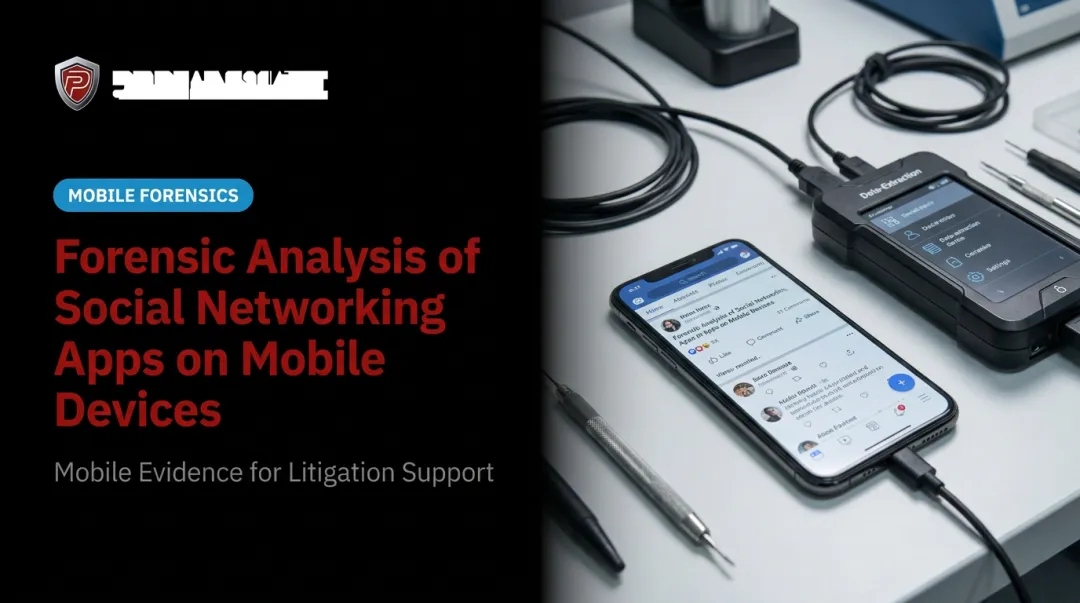
- Posts and captions, including deleted content recoverable through device forensics or platform preservation requests
- Photos and videos, where background details, clothing, and companions often matter as much as the primary subject
- Geotagged locations and check-ins that place a person at a specific location at a specific time
- Timestamps that corroborate or contradict a claimed timeline
- Account connections — followers, following lists, and mutual networks that map relationships
Innocuous posts carry real investigative weight. A restaurant check-in posted during the window of an alleged alibi has disproved it. Vacation photos posted during a claimed period of incapacitation have surfaced in civil fraud proceedings. Content doesn't need to look suspicious to be significant.
Private Content and Metadata
Private messages, disappearing content, and closed group communications require formal legal process — typically a warrant — to obtain from platforms. But metadata can be independently powerful even without message content:
- IP addresses tied to account logins
- Device identifiers linked to specific hardware
- Login timestamps establishing presence or absence at a given time
- EXIF data embedded in photos, which can include GPS coordinates and device information

The FBI's own guidance on EXIF data warns that photo metadata can reveal location information the poster never intended to share.
In warrant return analysis engagements, Prudential Associates' certified examiners parse private messages, activity logs, account metadata, and geolocation records to build chronological timelines and network maps — output that can corroborate or challenge any party's account in a proceeding.
Their team holds credentials directly applicable to this work, including the Certified Social Media Intelligence Expert (CSMIE) from the McAfee Institute, EnCase Certified Examiner (EnCE), and Magnet Certified Forensic Examiner (MCFE).
Deleted and Altered Content
Deletion is not permanent. Platforms preserve data in response to formal preservation requests — Meta and TikTok both preserve account data for 90 days on a valid request, with possible extensions. Beyond platform preservation, device forensics can recover:
- Cached posts and media that never cleared from local storage
- Deleted direct messages recovered from app data
- Draft content that was never published
- Thumbnail images and previews retained after source files were removed
Device seizure and social media investigation are often conducted in parallel for this reason. The phone in a suspect's pocket may hold social media evidence that has already been purged from the platform — making the device itself the more reliable source.
Social Media as Evidence in Court: Admissibility and Legal Standards
The Two Core Hurdles
For social media evidence to reach a jury, it must clear two legal thresholds:
- Authentication — proving the post, account, or message genuinely belongs to the person it's attributed to, and hasn't been fabricated or altered
- Relevance and hearsay — establishing that the content is relevant and either qualifies as a party admission or falls under a recognized hearsay exception
Federal Rule of Evidence 901 requires the proponent to produce evidence sufficient to support a finding that the item is what they claim it is. Courts have applied this stringently to social media.
Authentication Challenges
The Second Circuit's decision in United States v. Zhyltsou (2014) is the clearest warning: a social media profile was admitted at trial based on the defendant's name and photo appearing on the account. The Circuit reversed the conviction — name and photo alone are not sufficient proof of authorship or control.
Courts have accepted a range of authentication approaches:
- Corroborating metadata linking the post to a specific device or IP address
- Device records showing the account was accessed from the defendant's phone
- Writing style analysis compared to other authenticated communications
- Testimony from recipients of the communications
- Platform records confirming the account's ownership details

The National Association of Attorneys General notes that courts often require confirming circumstances that tie the account or specific post to the alleged author — not just platform identity.
The Stored Communications Act and Fourth Amendment
The Stored Communications Act (SCA) creates a tiered access system that favors prosecutors: law enforcement with proper legal process can compel platform disclosures that civil litigants and public defenders cannot access through the same channels. This disparity creates a structural asymmetry in who can access platform-held evidence.
On the Fourth Amendment side, Carpenter v. United States (2018) established that government acquisition of historical cell-site location information constitutes a Fourth Amendment search requiring a warrant. Courts have begun extending that principle to other forms of granular location data tied to digital accounts.
Public posts carry no such protection. Private communications, location history, and account access records, however, sit in increasingly contested legal territory — and that line continues to shift as courts confront new fact patterns.
Common Social Media Crimes
Social media has lowered the barrier to certain crimes — mass messaging makes harassment scalable, anonymous accounts enable fraud at volume, and group features facilitate coordinated criminal activity. But those same features generate the evidence trail investigators follow.
The most frequently prosecuted social media crimes include:
- Cyberstalking and online harassment — threatening DMs, coordinated pile-ons, and location-based surveillance via social platforms
- Fraud and financial crimes — romance scams, investment fraud, and impersonation schemes built on fake profiles. The FTC reported $2.7 billion in losses from scams originating on social media since 2021, with investment and romance scams leading categories
- Sextortion — NCMEC recorded an average of 137 financial sextortion reports per day in 2025, a 37% increase over the prior year
- Child exploitation and grooming — NCMEC's CyberTipline surpassed 36.2 million reports in 2023, covering over 105 million reported data files
- Coordinated threats and incitement — Elonis v. United States (2015) established that threatening Facebook posts require more than a negligence standard for criminal liability

Each crime type carries its own investigative complexity. Cyberstalking cases hinge on piercing anonymous account layers to establish identity. Fraud investigations typically require tracing social media personas to cryptocurrency wallets or financial accounts — a task that crosses platforms and jurisdictions. For sextortion and child exploitation cases, speed is the decisive factor: platform cooperation and preservation requests must happen before data is purged.
Using Social Media for Crime Prevention
Law enforcement agencies have moved well beyond passive monitoring. The same platforms used to collect evidence are actively used for community safety:
- Real-time alerts — agencies push crime alerts, wanted fugitive information, and safety warnings directly to followers. The FBI El Paso field office's 2023 Facebook launch specifically cited posting wanted fugitives' photos and soliciting public tips as primary use cases
- Tip solicitation — the January 6 investigation demonstrated citizen-sourced digital evidence at unprecedented scale
- Community outreach — the 2016 IACP survey found 89% of agencies used social media for community outreach and 86% for public relations
Community members function as a distributed intelligence network, sharing suspicious vehicle descriptions, missing person updates, and eyewitness reports across hyperlocal networks faster than traditional dispatch systems.
The same proactive model applies to corporate security. Organizations face comparable threats — brand impersonation, planned disruptions, insider activity — that surface first on open social networks and underground forums. Prudential Associates' OSINT and social media intelligence services monitor executive mentions, corporate assets, and brand references across these channels concurrently, with dark web monitoring running alongside. Early detection through continuous social monitoring gives organizations time to act before threats reach critical stages.
Challenges, Risks, and Limitations
Context and Reliability Problems
Social media content exists on a spectrum from literal statement to performance to satire. Courts and investigators who treat every post as a straightforward declaration of intent risk serious errors.
Rap lyrics, gaming personas, hyperbolic arguments, and roleplay communities all generate content that can look threatening or incriminating when stripped of context. The New Jersey Supreme Court's ruling in State v. Skinner (2014) flagged this danger directly, holding that performative content (rap lyrics, in that case) requires adequate consideration of its artistic and social context before admission.
The principle carries into investigative work. A post about violence in a gang-affiliated community may be bravado or genuine criminal communication — and metadata alone won't tell you which. Distinguishing between them requires sociocultural context that technical analysis can't supply.
Civil Liberties and Investigative Overreach
The Brennan Center describes U.S. government social media surveillance as a growing and unregulated trend that raises civil liberties concerns. Their 2024 principles specifically flag the risk of unfettered police surveillance imperiling constitutional rights and marginalized communities.
The ACLU has similarly warned that law enforcement social media surveillance software can sweep activists and constitutionally protected speech into digital monitoring programs. No comprehensive federal regulation governs how agencies conduct social media monitoring, including what data can be retained, for how long, and how it may be used. That gap creates real exposure for agencies that haven't established clear internal guidelines.
For attorneys working in this space, these limitations cut both ways:
- Evidence obtained through overreaching surveillance may face suppression motions
- Defendants monitored without adequate legal predicate may have viable Fourth Amendment claims
- Agencies lacking documented policies are vulnerable to both civil litigation and evidentiary challenges
Frequently Asked Questions
In what ways can social media be used in criminal investigations?
Investigators use social media to identify suspects, establish timelines, locate witnesses, gather public tips, monitor gang networks, and compel platform records through warrants and court orders. Open-source monitoring of public content and formal legal process for private data each serve distinct roles — and effective investigations typically require both.
Can social media posts be used as evidence in court?
Yes — social media posts are admissible when they meet authentication requirements under FRE 901 and clear relevance and hearsay standards. Courts require proof that the post was actually made by the named party, typically through corroborating metadata, device records, or testimony— a profile name alone is not sufficient.
How does social media impact criminal cases?
Social media can strengthen prosecutions by establishing intent, associations, and contradicting alibis. It can also complicate cases through fabricated profiles, content misread out of context, and the asymmetry between prosecution and defense access to platform-held evidence under the Stored Communications Act.
Is invasion of privacy a criminal charge?
In many U.S. jurisdictions, yes — though applicable statutes vary significantly by state. Unauthorized account access, nonconsensual intimate image sharing, and digital stalking can each carry criminal liability under specific federal and state laws, depending on the conduct and platform involved.
Which is an example of a social media crime?
Three common examples: threatening communications sent through Instagram or Twitter DMs (cyberstalking/criminal threats); investment fraud schemes built on fake LinkedIn or Facebook profiles (wire fraud); and child grooming conducted through Snapchat or TikTok direct messages (federal exploitation statutes).