Introduction
Attorneys already carry an impossible load: managing complex cases, processing mountains of electronic evidence, hitting court deadlines, and maintaining client relationships—all while being expected to focus entirely on legal strategy. Something has to give, and too often, it's case quality.
According to Thomson Reuters, small-firm attorneys spend roughly 40% of their working time on marketing, business development, and administration rather than practicing law—and 74% say excessive administrative burden is at least a moderate challenge.
Litigation support is the infrastructure that fixes that. It covers specialized services—document management, eDiscovery, digital forensics, and trial preparation—that attorneys can delegate to trained professionals, freeing them to focus on legal strategy.
This guide covers what litigation support includes, which services matter most, and what to look for when choosing a partner.
Key Takeaways
- Litigation support covers all consulting, technical, and administrative services helping attorneys prepare and manage court cases
- Core services include document management, legal research, eDiscovery, digital forensics, and trial preparation
- Electronic evidence now drives most litigation; eDiscovery and digital forensics are standard requirements on complex cases
- Vetting a support partner means confirming certifications, chain-of-custody practices, and data security protocols
- Expert witness testimony and court-admissible reporting are critical deliverables — confirm your provider has documented courtroom experience before retaining them
What Is Litigation Support?
Litigation support is the full spectrum of specialized services that assist attorneys across every phase of a case: pre-litigation risk assessment, discovery, trial preparation, and post-trial administration. It goes well beyond paralegals and expert witnesses.
The ILTA describes litigation support as a professional discipline at the intersection of law, technology, and business. It has evolved from reactive administrative work into a structured field using forensic collection methods, predictive coding, and specialized workflows. That evolution matters because it redefines what attorneys can realistically handle on their own.
Why Attorneys Can't Do It Alone
When attorneys get pulled into document sorting, records retrieval, data management, and scheduling, case performance suffers. The Clio 2025 Legal Trends Report shows a 38% utilization rate, meaning roughly 5 hours of an 8-hour lawyer day go unbilled. Administrative burden is a significant contributor.
Litigation Support vs. Paralegals
These roles overlap but are not interchangeable:
| Role | Focus |
|---|---|
| Paralegal | Case management, client communication, legal document drafting within the firm |
| Litigation Support Specialist | eDiscovery, digital forensics, forensic accounting, trial technology—often sourced externally |
Litigation support covers more technical ground. Outside specialists bring certifications, forensic laboratory infrastructure, and tools—such as mobile device extraction platforms and predictive coding systems—that most in-house teams cannot maintain economically.

Core Litigation Support Services for Law Firms
Litigation support covers everything from document management and legal research to eDiscovery, trial technology, and records retrieval. Understanding what each service includes — and when to deploy it — determines how much value attorneys actually extract from their support teams.
Legal Document Management and Filing
Document management covers organizing, categorizing, and processing high volumes of case materials—and ensuring electronic filings reach courts on time. In complex, multi-party cases, this extends to managing full document repositories accessible across legal teams.
Missed filing deadlines can result in dismissal or sanctions. The administrative function is, in practice, a liability management function.
Firms like Prudential Associates integrate document management directly into their litigation support workflow, including assessment of documents for relevancy, privilege, and confidentiality to accelerate the review process—not just storage and retrieval.
Legal Research, Drafting, and Case Strategy
Litigation support teams conduct case law research, identify precedents, and assist with drafting motions, pleadings, and demand letters. Strong teams don't stop at research delivery — they identify case weaknesses early and help develop stronger legal arguments before they're tested in front of a judge.
Prudential Associates provides legal and factual research through subscription-based legal databases, along with investigative case analysis that surfaces critical insights from discovery materials.
eDiscovery and Litigation Holds
Electronically stored information (ESI) — emails, texts, cloud data, social media content — makes up the vast majority of evidence in litigation. eDiscovery specialists manage the identification, preservation, collection, review, and production of this data.
What a litigation hold means in practice:
A litigation hold is a formal legal obligation that arises the moment litigation is reasonably anticipated. It requires preserving all potentially relevant evidence. Under FRCP Rule 37(e), failure to take reasonable steps to preserve ESI can result in:
- Court-ordered remedial measures
- Adverse inference jury instructions
- Dismissal or default judgment (when intentional destruction is found)
Cases like Zubulake v. UBS Warburg and GN Netcom v. Plantronics established how severely courts respond to preservation failures—including multi-million dollar sanctions.
Trial Preparation and Courtroom Support
Trial support encompasses far more than printing exhibits. Full-service providers handle:
- Deposition summaries and transcript synchronization with video
- Custom demonstratives, graphics, timelines, and animations
- Courtroom technology management (projectors, monitors, document cameras)
- Mock trials, focus groups, and jury research
- Remote deposition support via platforms like Zoom
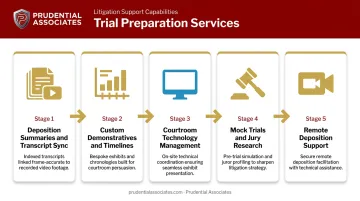
Prudential Associates' trial technology team uses platforms including ExhibitView and TrialPad. On-site and remote technicians adapt in real time to courtroom developments, displaying unexpected evidence or modifying exhibits mid-testimony as needed.
Records Retrieval
Records professionals obtain medical, financial, employment, and other third-party records via subpoena or authorization. Incomplete or inaccurate records remain a persistent weak point across personal injury, financial fraud, and employment litigation — often because firms underestimate the time and precision the process requires.
Prudential Associates also handles FOIA requests, obtaining records from federal, state, and local agencies nationwide for cases where government records are central to the dispute.
Digital Forensics and eDiscovery: The Technical Backbone of Litigation
The global eDiscovery services market is projected to grow from $10.81 billion in 2024 to $15.57 billion by 2029, according to ComplexDiscovery—a reflection of how central electronic evidence has become across every practice area, not just cybercrime.
Forensic Data Collection and Chain of Custody
Digital forensics begins with defensible collection from computers, smartphones, servers, and cloud environments. Improperly collected evidence can be challenged and excluded, potentially collapsing a case—so collection methodology is never a formality.
Certified forensic examiners follow strict protocols to document every step. Chain-of-custody records establish who handled evidence, when, and how—making the data traceable and credible in court. Certifications like CFCE (Certified Forensic Computer Examiner) and EnCE (EnCase Certified Examiner) signal that an examiner follows recognized, court-tested methodologies.

Prudential Associates maintains multiple CFCE and EnCE certified examiners and operates an in-house forensic laboratory with specialized data-extraction and mobile device equipment.
Device and ESI Analysis
Once data is collected, examiners analyze:
- Deleted files recovered from unallocated disk space
- Metadata revealing when files were created, modified, or accessed
- Communication records including emails, messages, and call logs
- System artifacts showing application use, login history, and device activity
Industry-standard platforms used by certified examiners include EnCase (OpenText), Cellebrite, and Magnet AXIOM. Active certifications in all three platforms—EnCE, Cellebrite Certified Physical Analyst, and Magnet Certified Forensic Examiner (MCFE)—confirm Prudential Associates uses these tools operationally, not just on paper.
This analysis can uncover spoliation, establish timelines, and directly corroborate or contradict witness statements.
Social Media Intelligence and Dark Web Investigations
Social media content—posts, messages, geolocation data—appears regularly in personal injury, employment, fraud, and family law cases. In Gatto v. United Air Lines, a plaintiff who deactivated their Facebook account during litigation received spoliation sanctions and an adverse inference ruling.
Certified Social Media Intelligence Experts (CSMIE) legally obtain and preserve this evidence in a forensically sound, court-admissible format. Prudential Associates has CSMIE-certified staff on staff, offering two levels of investigation—from open-source data collection across Facebook, TikTok, and Instagram to exhaustive expert analysis—along with warrant return analysis for court-ordered social media disclosures.
For corporate fraud, IP theft, and criminal defense matters, dark web monitoring extends the investigation further: identifying stolen data, illicit transactions, or threat activity relevant to litigation. Prudential Associates deploys proprietary methodologies for dark web investigations, including undercover operations in dark web communities and threat actor profiling—capabilities that go beyond standard eDiscovery providers.
Expert Witness Preparation and Testimony Support
Digital forensic examiners often serve as expert witnesses, translating complex technical findings into clear, credible testimony for judges and juries. The examiner's methodology and credentials will both be challenged by opposing counsel—so selecting someone with recognized certifications (CISSP, GCFA, CEH) and direct courtroom experience matters.
Prudential Associates' CEO has testified in court more than 500 times across local, state, and federal jurisdictions. The firm's examiners have participated in hundreds of depositions and authored written declarations and affidavits supporting legal motions and court strategies.
Benefits of Litigation Support for Law Firms
Time Recovery and Case Focus
With 40% of attorney time consumed by non-legal tasks, delegating document management, records retrieval, eDiscovery, and technical analysis to specialized teams produces a direct, measurable return: more time on strategy, client relationships, and case outcomes.

Financial Flexibility and Scalability
Most firms don't need a full-time forensic examiner, eDiscovery manager, and trial consultant on staff for every case type. On-demand litigation support lets you access those capabilities when a case requires them — and step back when it doesn't.
Prudential Associates structures engagements around this reality, offering hourly and flat-fee arrangements with virtual consultation options so firms can match resources to case complexity without carrying fixed overhead year-round.
Risk Mitigation
Proper litigation holds, defensible evidence collection, and certified chain-of-custody documentation protect firms from:
- Court sanctions for spoliation
- Malpractice exposure from mishandled digital evidence
- Adverse rulings from inadmissible or challenged forensic work
When collection, analysis, and testimony follow a certified, documented methodology, opposing counsel has far less ground to challenge — and judges have far less reason to exclude.
How to Choose the Right Litigation Support Partner
Choosing the wrong provider can mean missed deadlines, inadmissible evidence, or a methodology challenge that derails an otherwise strong case — so the selection process deserves the same rigor you'd apply to any expert witness.
Verify Credentials and Technical Certifications
For technical litigation support—especially digital forensics and eDiscovery—certifications are the clearest indicator of methodological rigor. Look for:
- CFCE – Certified Forensic Computer Examiner (IACIS)
- EnCE – EnCase Certified Examiner (OpenText)
- CEDS – Certified eDiscovery Specialist (ACEDS)
- CISSP – Certified Information Systems Security Professional (ISC2)
- GCFA – GIAC Certified Forensic Analyst

Prudential Associates holds all of these plus mobile forensic certifications (Cellebrite, GASF), specialized investigation credentials (CFE, CEH, OSCP), and social media intelligence certifications—over 30 professional credentials across the team.
Assess Experience with Legal Standards and Admissibility
Technical expertise alone isn't enough. The provider must understand FRCP compliance, FRE authentication requirements, and how their work will be scrutinized in court. Ask:
- How do you document chain of custody?
- What is your expert testimony track record?
- How have you responded when opposing counsel challenged your methodology?
Evaluate Scope and Case Fit
Complex litigation often requires multiple disciplines simultaneously — document review, digital forensics, financial investigation, and social media intelligence. A provider with verified expertise across disciplines reduces coordination burden and eliminates gaps between service providers.
Ask specifically about experience with your case type:
- Corporate fraud and financial disputes
- Employment litigation and workplace investigations
- IP theft and trade secret cases
- Cybercrime and data breach matters
- Personal injury and accident reconstruction
- Divorce and family law proceedings
Confirm Data Security and Confidentiality Protocols
Litigation data is among the most sensitive material a law firm handles. Verify:
- Secure data environments with appropriate access controls
- Privilege protection procedures for attorney-client communications
- Compliance with relevant data security standards (NIST, ISO 27001)
Prudential Associates brings CISSP-certified staff and a CrowdStrike partnership for managed detection and response to every engagement — a security infrastructure purpose-built for sensitive investigations, not retrofitted from a standard legal vendor model.
Frequently Asked Questions
What is litigation support?
Litigation support encompasses all consulting, technical, and administrative services that assist attorneys in preparing and managing court cases—from document management and eDiscovery to digital forensics, trial preparation, and expert witness services. It covers the full case lifecycle, not just individual tasks.
What is the difference between a paralegal and a litigation support specialist?
Paralegals primarily assist attorneys with case management, legal research, drafting, and client communication within the firm. Litigation support specialists cover a broader, more technical range—including eDiscovery, digital forensics, forensic accounting, and trial technology—and are often external experts brought in for specific case needs.
How serious is a litigation hold?
A litigation hold is a legal obligation triggered once litigation is reasonably anticipated. Failure to preserve relevant evidence can result in court sanctions, adverse inference jury instructions, or case-dispositive rulings. It must be implemented immediately and documented thoroughly.
What are the 5 C's of attorney-client privilege?
The five elements of attorney-client privilege are: Communication, Confidentiality, Client, Counsel, and Context (the communication must be made for the purpose of seeking legal advice). Digital evidence and metadata can inadvertently waive privilege if not handled with forensic care.
What types of cases benefit most from digital forensics support?
Digital forensics is essential in cybercrime, data breach, and IP theft matters, but it applies just as often in employment disputes, financial fraud, divorce proceedings, and personal injury cases where electronic communications or device activity bear on the facts.
Can small law firms access litigation support services?
Yes. Many providers offer services on a per-case or on-demand basis with hourly and flat-fee options. Small firms can access certified forensic examiners, eDiscovery specialists, and trial consultants without the overhead of full-time in-house hires. Prudential Associates structures engagements this way specifically to serve firms of all sizes.