What makes BEC uniquely dangerous is that it bypasses the defenses most enterprises already have. No malware. No malicious attachment. Just a convincing email from someone who appears to be a trusted executive, vendor, or legal contact.
This guide identifies the top enterprise email security vendors offering dedicated BEC protection in 2026, the features that separate them, and the criteria organizations should use to make the right choice.
Key Takeaways
- BEC attacks impersonate executives, vendors, or attorneys to manipulate employees into wire transfers or payment changes — no malware required
- They succeed through social engineering alone, making traditional antivirus and spam filters largely ineffective
- Top enterprise BEC protection vendors in 2026: Microsoft Defender for Office 365, Proofpoint Email Protection, Mimecast Advanced Email Security, Cisco Secure Email Threat Defense, and Abnormal Security
- All five are recognized as Leaders in the 2025 Gartner Magic Quadrant for Email Security
- Effective protection requires layered defenses — authentication, AI detection, identity controls, and employee awareness — no single tool covers everything
What Is BEC and Why Do Enterprises Need Dedicated Protection?
Business email compromise is an attack method where threat actors impersonate trusted parties — CEOs, CFOs, vendors, legal counsel — via spoofed or compromised email accounts. The goal is to manipulate recipients into initiating fraudulent wire transfers, sharing sensitive credentials, or changing payment details.
Because BEC relies entirely on social engineering rather than malware, it bypasses signature-based filters and most legacy security tools entirely — which is what makes it so dangerous.
How AI Has Changed the Threat in 2025–2026
The threat has escalated fast. The FBI's IC3 warned in 2024 that criminals are actively exploiting generative AI to commit fraud at greater scale — making BEC lures more convincing and enabling voice and video impersonation alongside email. The Verizon 2025 DBIR found that synthetically generated text in malicious emails doubled over two years, from roughly 5% to 10% of analyzed samples.
Attackers now harvest organizational data from LinkedIn and dark web leaks to build targeted pretexts. Hybrid BEC-vishing campaigns using voice-cloning have been documented by FBI field offices.
BEC Variants Enterprises Face
Organizations — particularly those in finance, legal, government, and professional services — must defend against multiple BEC forms:
- Payroll diversion — attacker redirects employee direct deposit to a fraudulent account
- Wire transfer fraud — CFO or executive is impersonated to authorize a large outbound transfer
- Vendor email compromise (VEC) — a supplier's email account is compromised to intercept or alter payment instructions
- W-2 and data theft — HR or finance staff are tricked into emailing sensitive employee records
- CEO/CFO fraud and attorney impersonation — high-authority accounts are spoofed to create urgency around approvals

Built-in email filters handle spam and malware. They are not built to catch a well-crafted impersonation that uses a legitimate-looking domain and references real organizational context. Dedicated enterprise-grade solutions close that gap by analyzing behavioral signals, domain relationships, and communication patterns — not just message content.
Top Enterprise Email Security Companies with BEC Protection in 2026
These vendors were evaluated on BEC detection capability, enterprise scalability, platform integration, and independent analyst recognition — all five hold Leader status in the 2025 Gartner Magic Quadrant for Email Security.
Microsoft Defender for Office 365
Microsoft Defender for Office 365 (Plan 2) is natively integrated within the Microsoft 365 ecosystem and widely deployed across large enterprises and government agencies. Core capabilities include anti-phishing, Safe Links, Safe Attachments, and AI-driven impersonation protection.
Its BEC advantage comes from deep ecosystem integration: Defender for Office 365 correlates email signals with identity data from Microsoft Entra ID and endpoint signals from the broader Microsoft Defender XDR platform, enabling correlated detection across email, identity, and endpoints simultaneously. Microsoft processes 100 trillion security signals daily, according to the Microsoft Digital Defense Report 2025, giving its detection engine substantial threat intelligence coverage.
| Feature | Detail |
|---|---|
| BEC-Specific Capability | AI-powered impersonation detection with identity correlation via Microsoft Entra ID; covers CEO fraud, domain spoofing, and lookalike domains |
| Deployment | Cloud-native, natively integrated with Microsoft 365; no MX record change required for M365 tenants |
| Best For | Large enterprises and government agencies already standardized on Microsoft 365 seeking unified security management |
Proofpoint Email Protection with Targeted Attack Protection
Few email security vendors match Proofpoint's global deployment scale. Its Email Protection platform, augmented by Targeted Attack Protection (TAP), addresses advanced BEC, impersonation, phishing, malware, and insider risk across cloud and on-premises environments.
Proofpoint's differentiator is its people-centric approach: Very Attacked People (VAP) intelligence identifies which individuals are most frequently targeted, enabling adaptive, identity-aware controls where they matter most. Its BEC and email fraud defense module applies machine learning to detect display name deception, lookalike domains, and compromised supplier accounts, with low false-positive rates.
Proofpoint's Nexus Threat Graph analyzes over 2.6 billion daily emails and 49 billion daily URLs, according to Proofpoint's Nexus documentation. It holds Leader status in both the 2025 Gartner Magic Quadrant and Forrester Wave Q2 2025 for Email Security.
| Feature | Detail |
|---|---|
| BEC-Specific Capability | Email Fraud Defense with VAP analysis; vendor/supplier compromise detection; lookalike domain and display name spoofing prevention |
| Deployment | Cloud-based or hybrid; supports Microsoft 365, Google Workspace, and on-premises Exchange |
| Best For | Enterprises with complex vendor ecosystems and high-value targets requiring granular, identity-aware BEC controls |
Mimecast Advanced Email Security
Mimecast is a long-established enterprise email security provider recognized as a Leader in the 2025 Gartner Magic Quadrant for Email Security. Its Advanced Email Security platform includes a dedicated Advanced BEC Protection module with real-time impersonation detection, DMARC Analyzer, and social graph analysis of user communication patterns.
Where Mimecast stands out is its combination of AI detection with known threat signatures. This dual-layer approach reduces blind spots when attackers deploy novel techniques that pure-AI models haven't yet encountered. Social graph modeling maps each user's normal communication network; messages from outside that pattern trigger additional scrutiny.
The platform's policy simulation feature lets administrators test policy changes against historical message data before deployment, meaningfully reducing tuning time for large security teams.
| Feature | Detail |
|---|---|
| BEC-Specific Capability | Advanced BEC Protection module with semantic analysis, social graph modeling, and risky-phrase detection; integrated DMARC Analyzer |
| Deployment | 100% SaaS; supports Microsoft 365 and Google Workspace via API and MX routing |
| Best For | Mid-to-large enterprises needing detailed BEC triage visibility and streamlined DMARC enforcement alongside human risk management |
Cisco Secure Email Threat Defense
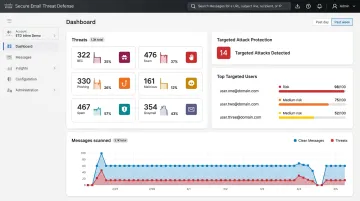
Built specifically for enterprise BEC and advanced phishing detection, Cisco Secure Email Threat Defense uses AI and machine learning to analyze relationships, communication patterns, and content signals to identify attacks that bypass traditional signature-based filters.
Cisco's primary differentiator is its Talos threat intelligence network, which feeds real-time signals into the email detection engine, catching newly identified BEC campaigns before they reach enterprise inboxes. Talos's IP and Domain Intelligence Center provides continuous email and spam trend visibility. Cisco Secure Email Threat Defense also integrates with the broader Cisco Security Cloud and Cisco XDR platform for unified visibility.
| Feature | Detail |
|---|---|
| BEC-Specific Capability | AI-driven behavioral analysis with Talos threat intelligence; forged email and executive impersonation detection; URL scanning for post-delivery protection |
| Deployment | Cloud-native; integrates with Microsoft 365 and Google Workspace; part of Cisco Security Cloud ecosystem |
| Best For | Enterprises with existing Cisco security infrastructure seeking unified threat visibility and BEC detection powered by Talos intelligence |
Abnormal Security
Abnormal Security is an AI-native cloud email security platform built specifically to detect the attack types that traditional secure email gateways miss: BEC, vendor email compromise, payroll fraud, and account takeover.
Unlike signature-based solutions, Abnormal uses behavioral AI to establish a baseline of normal communication patterns for every user and every third-party vendor, then flags statistical deviations with no reliance on known threat signatures. Its API-based architecture requires no MX record change, deploying as an overlay on an existing email gateway.
Abnormal reports stopping over 400 attacks per customer annually and delivering a 4x reduction in BEC threats reaching inboxes (vendor-reported figures). It holds Leader status in both the 2025 Gartner Magic Quadrant and Forrester Wave Q2 2025.
| Feature | Detail |
|---|---|
| BEC-Specific Capability | Behavioral AI baselines for all users and vendors; autonomous post-delivery remediation; account takeover detection; vendor email compromise (VEC) protection |
| Deployment | API-based, cloud-native; overlays on Microsoft 365 and Google Workspace without replacing the existing email gateway |
| Best For | Enterprises wanting AI-native BEC detection that complements an existing SEG, especially those with large vendor ecosystems vulnerable to VEC |
Key Features to Look for in Enterprise BEC Protection
Effective BEC protection requires a layered stack of capabilities. When evaluating vendors, enterprises should require all of the following:
Authentication Enforcement
SPF, DKIM, and DMARC form the required baseline. DMARC instructs receiving systems how to handle messages that fail authentication checks — and according to Valimail's 2024 DMARC adoption snapshot, over 80% of Fortune 500 companies now have DMARC records in place.
Authentication protocols alone, however, don't stop lookalike domains, compromised accounts, or AI-generated payment fraud. They must be paired with behavioral detection to close the gap.
Behavioral and Identity-Level Detection
Effective BEC detection must:
- Analyze sender behavior and communication patterns, not just message content
- Flag impersonation of internal executives or external vendors even when sender addresses appear legitimate
- Distinguish between a genuine CFO and an attacker mimicking CFO writing style and context
- Profile third-party vendors as well as internal users — VEC attacks exploit trusted supplier relationships

Operational and Integration Requirements
Enterprise deployments need:
- Native or API-based integration with Microsoft 365 or Google Workspace
- Granular admin controls for policy tuning and incident triage
- Actionable detection explanations — not just binary block/allow decisions — so security teams can determine root cause quickly
- Post-delivery remediation for messages that initially pass filters
Compliance and Audit Capabilities
Enterprises in regulated industries — finance, healthcare, government, legal — should verify that their chosen platform supports:
- Audit-ready logging and email archiving compatible with eDiscovery requirements
- Compliance reporting aligned with NIST CSF, CMMC, or SOC 2 frameworks
- Documented incident records that satisfy regulatory disclosure obligations when a BEC incident occurs
How We Selected These Enterprise Email Security Vendors
Each vendor on this list was evaluated against four criteria:
- BEC-specific detection — not general anti-spam performance, but targeted behavioral analysis for impersonation and fraud
- Analyst recognition by Gartner and Forrester for enterprise email security
- Enterprise deployment scale and a support model that fits large or complex organizations
- Verified effectiveness against modern BEC variants, including AI-generated impersonation and vendor email compromise (VEC)
Common Selection Mistakes to Avoid
Enterprises regularly make three evaluation errors:
- Over-relying on built-in email security — Microsoft 365's default email security lacks the depth of dedicated BEC behavioral analysis that Plan 2 or third-party solutions provide
- Choosing on brand name alone — BEC-specific detection accuracy matters more than general security reputation; always test against real-world BEC scenarios (payroll diversion, VEC) during proof-of-concept
- Skipping the vendor ecosystem test — a solution that profiles internal users but not third-party senders will miss VEC attacks, now among the most frequently reported BEC variants in recent incident data

Conclusion
No single email security tool eliminates BEC risk entirely. The five vendors covered here represent the strongest enterprise-grade options in 2026, but effective protection requires combining technology with email authentication enforcement, employee awareness training, and out-of-band payment verification protocols.
Fit matters more than rankings:
- Complex vendor ecosystems → prioritize VEC detection (Abnormal Security, Proofpoint)
- Microsoft 365-heavy environments → Microsoft Defender for Office 365 offers the deepest native integration
- DMARC management and BEC triage visibility → Mimecast's policy simulation and DMARC Analyzer offer operational advantages
- Cisco security infrastructure → Cisco Secure Email Threat Defense with Talos intelligence is the natural fit
Choosing the right platform is only part of the equation. When an organization needs to assess active BEC exposure, investigate a compromise, or build a defensible incident response plan, that work requires human expertise — not just software.
Prudential Associates provides that expertise to corporate clients, government agencies, and legal professionals. The firm's Compromised Email Investigations service covers point-of-compromise determination, unauthorized access identification, and forensic findings suitable for civil or criminal proceedings. Certified examiners hold GCFA, GCIH, CISSP, CEH, and CFE credentials, and a 2026 CrowdStrike partnership extends its Managed Detection and Response capabilities.
Contact Prudential Associates to discuss your BEC exposure and build a response plan aligned with your operational environment.
Frequently Asked Questions
What is a BEC (business email compromise) attack?
BEC is a cyberattack in which threat actors impersonate trusted parties — executives, vendors, or legal contacts — via spoofed or compromised email accounts to trick employees into transferring funds, sharing credentials, or altering payment details. Unlike most cyberattacks, BEC relies entirely on social engineering rather than malware, making it harder to detect with traditional security filters.
What are common red flags of a business email compromise?
Key warning signs include unexpected urgency around wire transfers or payment changes, requests to bypass normal approval processes, slight misspellings in domain names, instructions to keep communication confidential, and last-minute changes to vendor bank account details. Emails arriving from free consumer accounts rather than business domains are also a strong indicator.
How can organizations protect against BEC attacks?
A layered approach covers the most ground:
- Enforce SPF, DKIM, and DMARC email authentication
- Deploy an AI-based email security solution with behavioral BEC detection
- Require MFA on all email accounts
- Train employees to recognize executive and vendor impersonation attempts
- Verify all financial requests out-of-band — call a known number, never reply to the suspicious email
What's the best AI email security tool for BEC?
Leading options in 2026 include Abnormal Security (behavioral AI built natively for BEC), Microsoft Defender for Office 365 (identity signal correlation across the Microsoft stack), and Proofpoint TAP (ML-driven VAP identification). The right fit depends on your existing infrastructure and whether you're supplementing or replacing a traditional secure email gateway.
What's the best threat intelligence service for email security?
Cisco Talos, Proofpoint's Nexus Threat Graph (2.6 billion daily emails analyzed), and Microsoft's threat intelligence signals (100 trillion security events daily) are the three leading enterprise options. Each feeds real-time BEC campaign pattern data directly into its respective platform's detection engine.
What's the best incident response approach for email breaches?
Automated platforms like Microsoft Sentinel, Splunk SOAR, and Palo Alto XSOAR handle playbook execution well. For organizations in legal, government, or corporate settings, a managed firm with email forensics expertise — such as Prudential Associates — adds evidence preservation, rapid containment, and support for regulatory notification obligations that automated tools alone cannot provide.